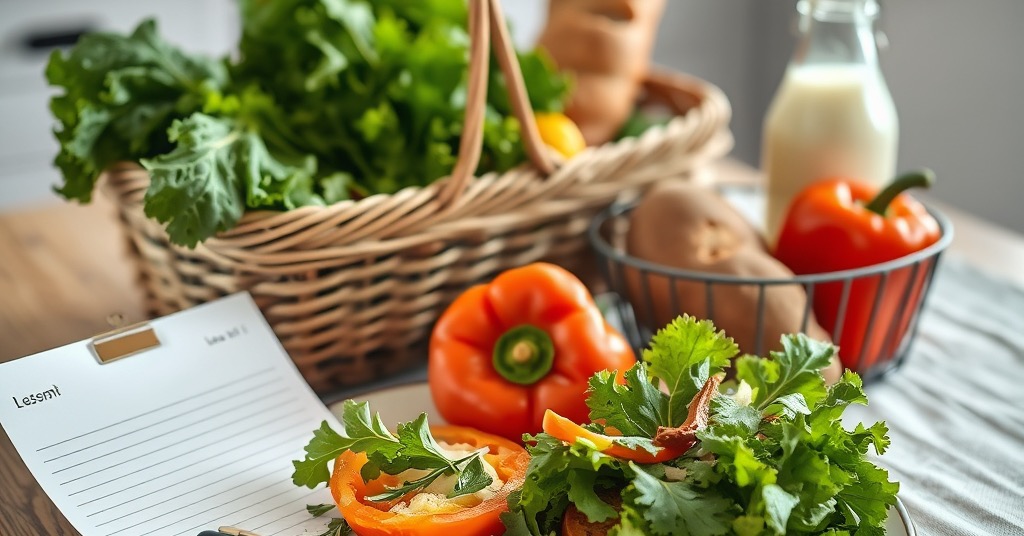
Most meal plans don't fall apart in the kitchen. They fall apart at the store. You planned five dinners on Sunday, but by Wednesday you're back in the shop buying the one ingredient you forgot — and three things you didn't need. A good weekly grocery list is what turns a plan on paper into a week that actually runs.
The good news: a grocery list is just your meal plan turned inside out. If you already know what you're cooking, the list almost writes itself. Here's the system, step by step.
1. Start With the Plan, Not the Store
Don't walk into the store and improvise. Decide what you're cooking first, then shop for exactly that. You don't need all 21 meals of the week planned — just pin down the ones that otherwise turn into takeout:
- Five dinners is plenty for most people. Leave a couple of evenings open for leftovers or spontaneity.
- Reuse ingredients across meals — if one recipe needs half a bunch of parsley, plan a second that finishes the rest.
- Pick a couple of recipes you already know by heart, so the week isn't all new and effortful.
What does your shopping cost? Check it in 30 seconds
Open the free grocery calculator →2. Pull Every Ingredient From Your Recipes
Go through your chosen recipes one by one and write down what each one needs — with the actual quantity, not just the name. "Tomatoes" is how you end up with one sad tomato for a dish that needed six.
- Note the amount next to every item: 500 g pasta, 400 g tinned tomatoes, 200 ml cream.
- Combine duplicates as you go — if three recipes need onions, add up the total instead of writing onions three times.
- Keep a single combined list, not one per recipe. You're shopping once, so you want one list.
3. Check Your Pantry Before You Add Staples
This is the step almost everyone skips, and it's where the money leaks. Before you finalize the list, look at what you already own. Most kitchens are quietly full of the basics recipes call for.
- Cross off staples you already have: oil, salt, spices, flour, rice, pasta, tinned goods.
- Check the fridge for half-used items — that block of cheese or the open jar of pesto.
- Only buy what's genuinely missing. A list of 18 items often shrinks to 12 once you actually look.
4. Sort the List by Store Section
A list written in the random order your recipes came up means criss-crossing the whole store and doubling back for the thing you missed. Group it the way the store is laid out instead:
- Produce: fruit, vegetables, fresh herbs.
- Meat & fish.
- Dairy & eggs: milk, cheese, yoghurt, butter.
- Frozen.
- Pantry: tins, pasta, rice, spices, baking.
- Bakery and everything else.
A categorized list does two quiet but powerful things: it gets you through the store faster, and it cuts impulse buys, because you move with purpose instead of wandering every aisle. As a bonus, most fresh, whole food lives around the perimeter — produce, meat, dairy — so a perimeter-first list tends to be a healthier one too.
5. Scale to the Number of People You're Feeding
Recipes are written for a fixed number of servings, and that number is rarely yours. Before you copy quantities onto the list, scale them. Cooking for two when the recipe serves four? Halve it. Want leftovers for lunch? Double it on purpose and let one dinner cover two days.
A Few Habits That Make the List Stick
The list itself is only half the job. These habits are what keep it working week after week:
- Shop once. Every extra trip is another chance to overspend and impulse-buy.
- Stick to the list in the store — the deciding already happened at home, so trust it.
- Keep a running note for things as they run out, so next week's list half-writes itself.
- Glance at what tends to spoil. Buying only what you'll actually cook is the simplest way to throw away less food and money.
Or Let Culinse Build the List For You
Every step above is exactly what Culinse automates. It's a free meal planner that turns your week into one smart shopping list, so the busywork disappears:
- Plan your week in a simple grid and Culinse builds one combined shopping list from every recipe — quantities added up, duplicates merged.
- The list arrives already sorted by store section, so you shop top to bottom without backtracking.
- Mark what you already own, and pantry items move into an "already have" section instead of the buy list.
- Set how many people you're feeding and every quantity scales automatically.
- Tick things off as you shop, and add anything extra by hand.
The manual system genuinely works — plenty of people run their whole week on a notebook and a pen. An app just handles the tedious parts: the adding-up, the sorting, the remembering. If you'd like the list built for you the moment you finish planning, plan your week free at culinse.com.