🤖 Rezept und Bild mit KI erstellt, redaktionell geprüft · Mehr zur KI-Transparenz
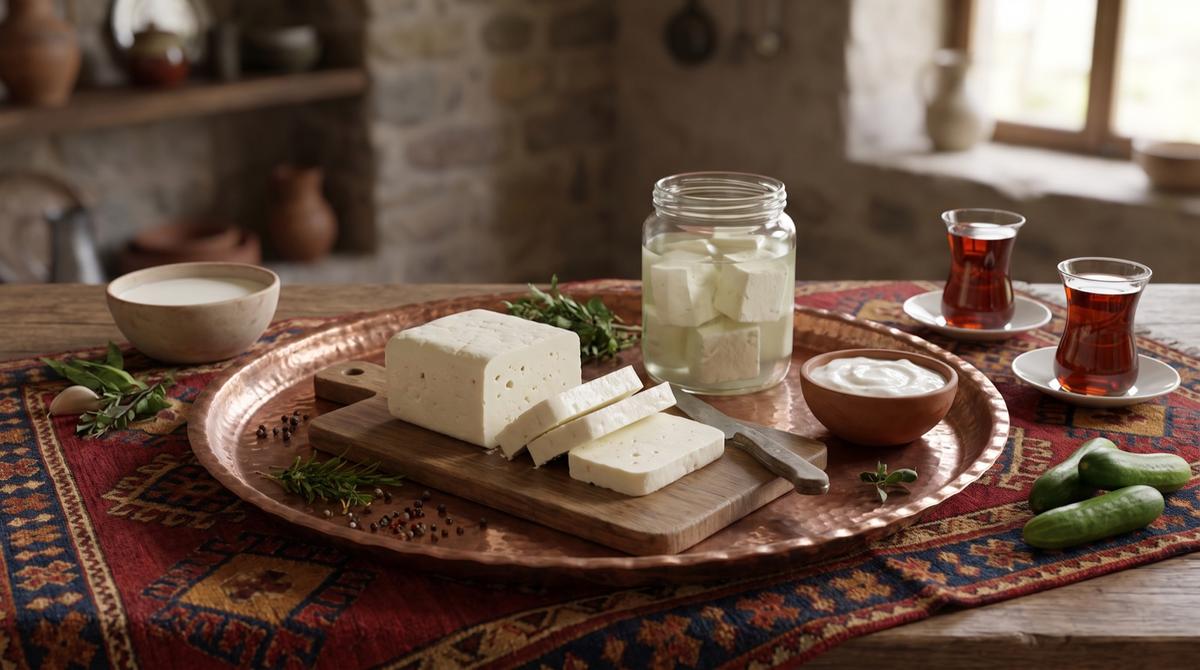
Penîr — Kurdish Homemade Cheese with Rennet
A basic Kurdish recipe used in every Kurdish region: Penîr is the white, sliceable homemade cheese made by setting lukewarm milk with rennet, pressing the curds in a cloth and steeping the cheese in brine. In Turkish it is called Beyaz peynir, in Arabic Jibne and in Persian Panir; at home it is made only from pasteurised whole milk, and after a day in the brine it is mild, lightly salty and moist. It belongs on the table at Taştê — the Kurdish breakfast with herb cheese, Qeymax, honey, olives and tea, goes crumbled into Parxaç — yoghurt and egg bread from the oven and is served in cubes with Zelateya kurdî — tomato, cucumber and onion salad with sumac.
Kochzeit
60 min
Portionen
6
Zutaten
6
Nährwerte
pro Portion241 kcal
Kalorien
15 g
Eiweiß
20 g
Fett
1 g
Kohlenhydrate
Zutaten
Für 6 Portionen
Zubereitung
- 1
Make the brine the day before or as the very first step: bring the water to the boil with the salt until it has dissolved and leave it to cool completely; this gives a brine of about 8 %. Cover and put it in the fridge.
- 2
Rinse a large pot (at least 6 l), a whisk, a ladle, a long knife, a kitchen thermometer, a large sieve and a thin cotton cloth with very hot water. Pour the milk into the pot.
- 3
Warm the milk slowly to 35 °C over a low heat, stirring gently, then take the pot off the heat; it must not get any warmer, otherwise the cheese turns rubbery.
- 4
Stir the rennet into the cooled water, pour it over the milk and draw the whisk through from top to bottom for one minute. Briefly still the milk with the ladle, put the lid on, wrap the pot in a thick towel and leave it to stand without moving it until the milk has set.
- 5
Test for a clean break: insert the knife into the curd at an angle and lift it slightly; if it breaks cleanly like a pudding and the gap fills with clear, yellowish whey, it is ready; otherwise leave it to stand for 10 to 15 minutes longer. Using the long knife, cut the curd right down to the bottom into strips 2 cm wide, turn the pot and cut across them to make cubes, then leave to rest.
- 6
Gently turn the cubes over from the bottom with the ladle until they are slightly smaller and firmer and plenty of whey has separated; do not stir as you would a dough, so that the curds do not fall apart.
- 7
Line the sieve with the cloth and set it over a large bowl. Ladle the curds into it, letting the whey run through and collecting it in the bowl.
- 8
Fold the ends of the cloth tightly over each other, press the parcel flat in a square dish or in the sieve, place a plate on top and weigh it down with about 2 kg, for example a pot full of water. Press in a cool place, turning the parcel once after an hour.
- 9
Take the cheese out of the cloth and cut it into pieces of about 5 cm. Place the pieces in a jar or container rinsed with hot water, cover them completely with the cold brine, seal and put in the fridge; after a day the cheese has taken on the brine and is ready to eat.
- 10
Tip: In the brine, the cheese keeps in the fridge for two weeks as long as it is always completely covered and taken out with a clean fork; soak cheese that is too salty in cold water for an hour before eating. Frozen, it turns crumbly and is then only good for fillings and gratins; as a shop-bought shortcut, use sheep's cheese or white cheese in brine from a Turkish shop. Animal calf rennet is not vegetarian, so microbial rennet is the best choice. Cheese matured in a skin bag (Penîrê meşkê) and cheese aged for months belong in a dairy, not in the kitchen.
Ähnliche Rezepte
 ⏱ 55 min
Taştê — das kurdische Frühstück mit Kräuterkäse, Qeymax, Honig, Oliven und Tee
 ⏱ 130 min
Tepsî — Auberginen, Paprika und Kartoffeln mit Hackbällchen aus dem Ofen
 ⏱ 55 min
Tike — marinierte Lammwürfel vom Spieß
 ⏱ 125 min
Tirşik nach Qamischli-Art — säuerlicher Sommergemüse-Eintopf mit Lamm
 ⏱ 40 min
Tirşî — gemischtes Eingelegtes mit Blumenkohl, Karotte, Gurke und Paprika
 ⏱ 33 min
Tolik bi hêk — Malve oder Spinat mit Ei
 ⏱ 145 min
Xoreşî xelal — Festtagseintopf mit Mandelstiften, Berberitzen und Safran
 ⏱ 25 min
Xoşav — Kompott aus getrockneten Aprikosen, Pflaumen und Rosinen