JapaneseTohokuMain courseLactose-free
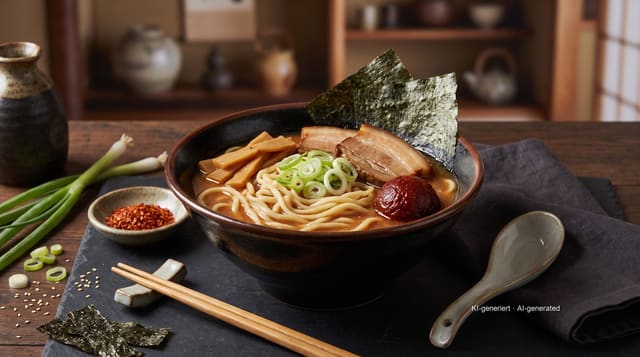
Akita-style Jumonji-Ramen with Thin Wavy Noodles
A Japanese classic from Tohoku: in Jumonji, a district of the city of Yokote in Akita Prefecture, a light, clear soy sauce broth with a delicate aroma of dried anchovies goes into the bowl, along with chashu, bamboo shoots and spring onions. Unlike Tsugaru ramen with its robust anchovy dashi, the anchovy broth here is light and clear, and the noodles are wafer-thin and wavy, so they cook in a minute. The broth tastes gently of the sea and of chicken, and with every bite a little of it clings to the fine waves of the noodles.
35
minutes
4
servings
8
Ingredients

Instructions
Put a large pot with plenty of unsalted water on to boil for the noodles — in lots of water the fine strands do not stick together, and no salt is needed because all the seasoning comes from the tare. Trim the spring onions, slice them into wafer-thin rings and keep them within reach next to the hob, because assembling the bowls has to be quick.
Combine the niboshi dashi and tori chintan in a second pot and heat slowly over a medium heat until the broth is steaming and small bubbles rise at the edge of the pot. Do not let it boil vigorously: the anchovy broth would turn cloudy and bitter, and its delicate aroma of the sea would vanish. Then keep the broth hot over a low heat.
Lay the chashu slices in the hot broth for 30 seconds, until the fat looks glassy and the meat is warm, then lift them out with a slotted spoon and set aside.
Fill four large bowls with hot water, leave them to stand briefly and pour the water away — in a warmed bowl the light broth stays hot down to the last spoonful. Put 3 tbsp shoyu tare and 1 tsp negi oil into each bowl; the tare provides the salt and seasoning, because both broths are unsalted.
Add the noodles to the rapidly boiling water, loosen them immediately with chopsticks and cook fresh noodles for just 1 minute, dried ones according to the packet — cooked any longer, the wafer-thin noodles go soft and lose their springy bite. Shake them vigorously in a sieve, because cooking water clings to the many little waves and would dilute the light broth.
Divide the hot broth between the bowls, about 400 ml each, and stir it together with the tare and oil until it is evenly light brown and clear, with small golden beads of fat floating on top.
Add the noodles, lift them once with chopsticks and lay them back down neatly so that the fine waves lie loosely in the broth and do not stick together in a tangle.
Arrange 2 slices of chashu, 2 tbsp menma and a small mound of spring onion rings in separate groups on top of each bowl and serve the ramen immediately. The thin noodles quickly soak up the broth and go soft, so eat straight away.
Edited by Peter Hölzer, head chef and master butcher
Similar recipes

Culinse · 85 min
Kiritanpo-Nabe — Akita-style Rice Stick Hotpot with Chicken

Culinse · 45 min
Yonezawa-Ramen with Chicken and Anchovy Broth

Culinse · 60 min
Imoni — Yamagata-style Taro Stew with Beef

Culinse · 60 min
Gyutan-yaki — Sendai-style Grilled Beef Tongue

Culinse · 45 min
Morioka-style Jajamen — Noodles with Miso Meat Sauce

Culinse · 45 min
Sendai-Miso-Ramen — Ramen with Red Sendai Miso

Culinse · 50 min
Tsugaru-Ramen with Rich Anchovy Dashi
Culinse · 50 min