JapaneseTohokuMain courseLactose-free
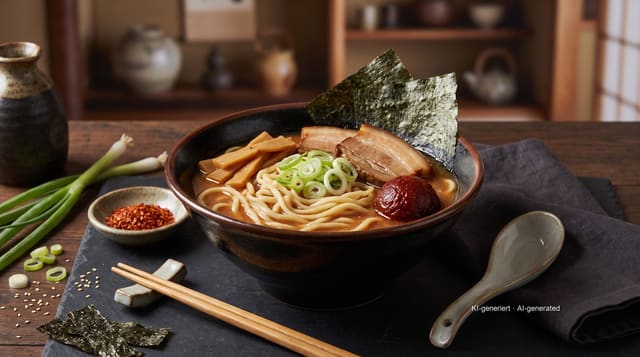
Tsugaru-Ramen with Rich Anchovy Dashi
A Japanese classic from Tohoku: in Tsugaru, the west of Aomori Prefecture with Hirosaki and the city of Aomori, the ramen broth tastes unmistakably of dried anchovies — robust, salty and savoury, with a subtle bitter note. Unlike Onomichi-Ramen with Anchovy Dashi, here twice as many dried anchovies steep for longer in the broth, which becomes cloudy and deeply savoury as a result, and instead of diced pork fat, only chashu, menma and spring onion go on top. The anchovies soak in the cold chicken broth for half an hour beforehand so that they release their full aroma while steeping.
50
minutes
4
servings
9
Ingredients

Instructions
Pinch the heads off the dried anchovies and pick out the dark belly with the innards, because both make the broth bitter and rank. Just wipe the kombu with a damp cloth and do not wash it, because the white coating on the surface is flavour.
Put the anchovies and kombu in a pot, pour the cold tori-chintan over them and leave to soak. The anchovies become soft and pliable, and the broth already starts to take on their flavour.
Heat the pot slowly over a medium to low heat and take out the kombu with tongs as soon as the first small bubbles rise at the edge of the pot, because boiled kombu turns slimy and bitter. Let the anchovies continue to steep gently, half-covered, over a low heat; the surface should only move slightly and not bubble, otherwise the broth will turn unpleasantly bitter. The kitchen now smells strongly of the sea.
Pour the broth through a sieve into a second pot, pressing the anchovies lightly with a ladle so that their aroma goes into the broth. Here the broth may turn cloudy; that is part of the strong Tsugaru version. Keep it hot over a low heat without letting it boil.
Put a large pot of plenty of unsalted water on to boil for the noodles and slice the spring onions into fine rings. Put the chashu slices into the hot broth for 30 seconds until the fat shimmers translucently and the meat is warm, then lift them out and set them aside.
Fill four large bowls with hot water, leave them to stand briefly and pour the water out so that the broth stays hot in them. Put 3 tbsp shoyu-tare and 1 tsp negi oil in each bowl.
Add the noodles to the rapidly boiling water, loosen them with chopsticks and cook: fresh ones for 1 to 2 minutes, dried ones according to the packet instructions, until done but still firm to the bite. Shake them hard in the sieve until hardly any water drips from them, so that no cooking water dilutes the broth.
Pour the hot broth into the bowls and stir it with the tare and oil until it is evenly brown and slightly cloudy.
Add the noodles, lift them once with chopsticks and lay them back down neatly so that they sit loosely in the broth.
Arrange 2 slices of chashu, 2 tbsp menma and a small heap of spring onion rings in groups on top of each bowl and serve the ramen immediately.
Edited by Peter Hölzer, head chef and master butcher
Similar recipes

Culinse · 45 min
Yonezawa-Ramen with Chicken and Anchovy Broth

Culinse · 45 min
Wakayama-Ramen with Tonkotsu-Shoyu Broth

Culinse · 75 min
Vegetarian Shoyu-Ramen with Shiitake-Dashi
Culinse · 50 min
Akayu-Ramen with a Spicy Miso Ball

Culinse · 45 min
Aomori-style Miso Curry Milk Ramen

Culinse · 60 min
Shirakawa-Ramen with Seared Chashu and Wide Noodles

Culinse · 40 min
Yamagata-style Tori-Chuka — Ramen with Chicken in Soba Broth

Culinse · 65 min