JapaneseMain courseLactose-freeHigh protein
Katsu KareJapanese Curry with Breaded Pork Cutlet
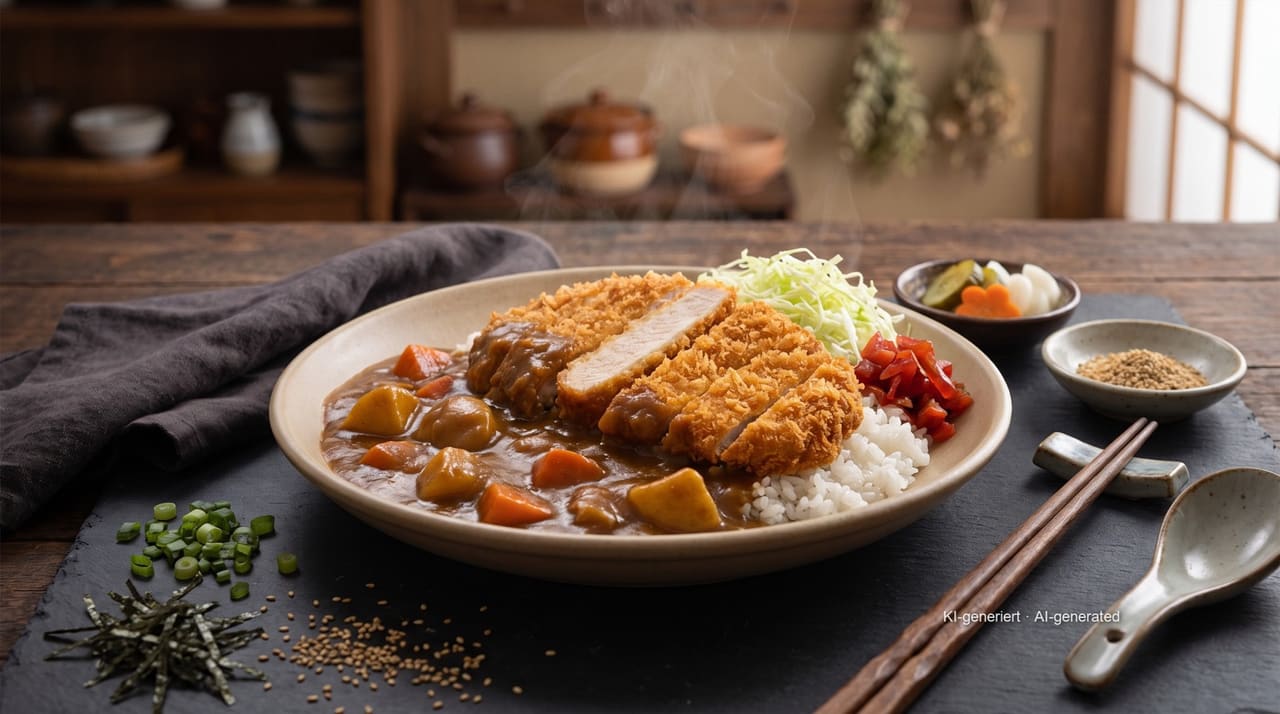
A Japanese classic served all over Japan in curry shops, canteens and family kitchens: Katsu Kare brings together the mild, thick and slightly sweet Japanese curry sauce and a crisp pork cutlet on a plate of rice. Unlike Japanese Curry — Kare Raisu with Beef, no meat goes into the sauce here — the heft sits on top: a freshly fried tonkatsu cut into strips, over which the thick curry sauce is poured, just as curry shops in Tokyo and all over the country serve it. The sauce is made from scratch, from long-browned onions, carrot, potato and grated apple, toasted with flour and curry powder and simmered with broth until velvety.
70
minutes
4
servings
19
Ingredients
Instructions
Cook the rice following the basic recipe and keep it warm in the covered pot. While it cooks, make the curry sauce.
Peel and halve the onions and cut them into thin strips. Peel the carrot and cut it into thin slices; peel the potato and cut it into 1 cm cubes. Peel the apple and grate it finely; peel the garlic and ginger and grate them finely too.
Heat the oil in a wide pot and fry the onions over a medium heat, stirring frequently, until they are soft, collapsed and golden brown and smell sweet: this long browning gives the sauce its depth and a natural sweetness. If they catch on the bottom, add a tablespoon of water and scrape the browned residue loose with the wooden spoon.
Add the carrot, potato, apple, garlic and ginger and fry them with the onions, stirring, until the garlic and ginger smell strongly and the carrot is glossy at the edges.
Sprinkle over the flour, curry powder and garam masala and toast them, stirring constantly, until no white flour is visible any more and the spices smell warm and nutty. Do not let it get too hot, because burnt curry powder tastes bitter.
Gradually pour in the broth while stirring vigorously, first just a splash until a thick, smooth paste forms, then the rest; this way no lumps form. Stir in the tomato paste, soy sauce, sugar and salt and bring the sauce to the boil.
Let the sauce simmer uncovered over a low heat, stirring often along the bottom, until the potato cubes are soft and the sauce is thick enough to coat a spoon completely. If it is still too thin, cook it down for a few minutes longer; if it is too thick, stir in a splash of water.
While the sauce simmers, remove the outer leaves and core from the white cabbage, roll the leaves up tightly and cut them into wafer-thin, thread-fine strips. Put the strips in iced water so that they turn crisp, and drain them well or spin them dry before serving.
Fry the tonkatsu freshly following its separate recipe (see recipe Tonkatsu — Breaded Pork Cutlet with Shredded Cabbage and Tonkatsu Sauce); all the advice on handling the hot oil safely is given there too. After resting, a meat thermometer must show at least 70 °C at the core, the juices that run out must be clear and the meat must be pale inside with no pink patches. Meanwhile, keep the sauce warm over the lowest heat and stir it now and then so that it does not catch.
Cut each cutlet crosswise into 2 cm wide strips with a sharp knife, pressing the blade firmly through the crust rather than sawing so that the coating does not crumble off. Leave the strips pushed together so that the cutlet keeps its shape.
Put the rice on one side of four deep plates and lay a cutlet at an angle against the rice on each. Ladle the hot curry sauce over only half of the cutlet and over the rice beside it, so that part of the crust stays crisp and crunches audibly as you eat. Place the cabbage and fukujinzuke at the edge of the plate and serve immediately.
Edited by Peter Hölzer, head chef and master butcher
Similar recipes

Culinse · 45 min
Katsu Sando — Cutlet Sandwich with Tonkatsu Sauce

Culinse · 40 min
Hirekatsu — Breaded Pork Fillet Medallions

Culinse · 80 min
Kare Pan — Deep-fried Buns with Curry Filling

Culinse · 45 min
Tebasaki — Crispy Nagoya-style Chicken Wings

Culinse · 20 min
Teriyaki Sauce — The Basic Recipe
Culinse · 35 min
Kansai-style Ozoni — New Year's Soup with White Miso and Mochi

Culinse · 40 min
Susaki-style Nabeyaki-Ramen

Culinse · 55 min