JapaneseMain courseLactose-freeHigh protein
Karaage-BentoDeep-fried Chicken with Rice and Side Dishes in a Box
A Japanese classic that is among the most popular bentos all over Japan, both in konbini, the little shops on every corner, and in bento shops: crisp deep-fried chicken with ginger and garlic, served with rice with a red salted plum in the centre, half a hard-boiled egg, simmered pumpkin, broccoli and cherry tomatoes. The chicken is made following a shortened version of the recipe Karaage — Crispy Deep-fried Chicken and tastes almost as good cold from the box as it does hot from the pot. The marinade contains sake and therefore alcohol, most of which evaporates during frying.
60
minutes
4
servings
15
Ingredients

Instructions
Cook the rice following the basic recipe; it goes into the boxes later while still warm and cools there uncovered. While it soaks and cooks, the chicken marinates.
Pat the chicken dry and cut it into pieces of about 4 cm, as evenly sized as possible, leaving the skin on the meat, because it turns crisp and keeps the meat juicy. Stir the soy sauce and sake together in a bowl, then peel the ginger and garlic and grate them finely into it. Knead the meat vigorously in the mixture with your hands until it has absorbed almost all of the marinade, then cover and leave to marinate in the fridge; wash the board and knife in hot water.
Meanwhile, bring plenty of water to the boil in a pot, lower the eggs into it with a spoon and hard-boil them over a medium heat. For the box they must be firm all the way through, including the yolk.
Lift out the eggs and put them in iced water so that they peel easily and the yolk does not develop a grey ring. Divide the broccoli into small florets and blanch them in the same water, still at a rolling boil, until bright green and still firm to the bite.
Refresh the broccoli in iced water, drain it and pat it thoroughly dry with kitchen paper, because moisture encourages germs in the closed box. Peel the eggs and halve them lengthways with a wet knife; the yolk is firm and pale yellow throughout. Wash the cherry tomatoes, pluck off the stalks and dry the tomatoes, and cut the lemon into eight narrow wedges.
Drain the meat in a sieve, because excess marinade would spit in the oil and burn quickly. Put the potato starch in a deep plate, turn each piece in it, press the starch on lightly and tap off the excess, then lay the pieces side by side on a wire rack until the starch looks damp in places: this way it sticks during frying and becomes a thin, crisp crust.
Pour the oil into a tall, heavy pot with a capacity of at least 3 litres, so that it is no more than a third full, and heat it to 170 °C; fine bubbles will then rise steadily from a dry wooden chopstick held in the oil. From now on never leave the pot unattended and do not let any water get into the oil; if it does catch fire, never try to put it out with water — put a lid on it and switch off the hob.
Slide half the pieces into the oil one at a time, without letting them touch, and fry until the crust is firm and pale yellow; the meat is not yet fully cooked inside at this point. Lift them out, lay them on the rack and fry the second half in the same way.
Leave the pieces to rest on the rack while the oil rises to 180 °C: the stored heat gently cooks the meat through to the centre. Then fry all the pieces a second time, in batches, until they are deep golden brown and the crust crackles audibly when tapped with a chopstick. The meat must be cooked right through: a thermometer will show 75 °C at the core, and clear juices will run out when it is cut.
Drain the Karaage on the rack, then switch off the hob under the oil and leave the pot to cool completely where it is. On the rack the crust stays crisp because the steam can escape downwards; on kitchen paper it would go soft.
Loosely fill half of each of the four boxes with the warm rice without pressing it down, scatter over the sesame seeds and set a salted plum in the centre of each. This creates the Hinomaru bento, named after the Japanese flag Hinomaru, “circle of the sun”: a red circle on a white ground.
Lay the Karaage, eggs, broccoli and tomatoes uncovered next to the boxes and let everything cool completely until nothing feels warm any more, including the rice in the boxes: warm food forms condensation under the lid, and germs multiply particularly quickly in moist warmth.
Put a quarter of the Karaage into each box with two lemon wedges, and an egg half beside them, cut side up. Divide the kabocha no nimono, broccoli and tomatoes between paper cases so that no juice runs into the rice, and fill the gaps so that nothing shifts when the boxes are carried. Only now close the lids and keep the boxes refrigerated.
Edited by Peter Hölzer, head chef and master butcher
Similar recipes

Culinse · 50 min
Tofu-Karaage-Ramen — Ramen with Crispy Deep-fried Tofu

Culinse · 70 min
Onigiri-Bento — Rice Balls with Omelette and Vegetables in a Lunch Box

Culinse · 40 min
Karaage — Crispy Deep-fried Chicken

Culinse · 65 min
Kitakata-Ramen with Wavy Noodles

Culinse · 60 min
Mito-style Stamina-Ramen with Liver and Vegetables

Culinse · 45 min
Toyama Black — Black Shoyu-Ramen
Culinse · 80 min
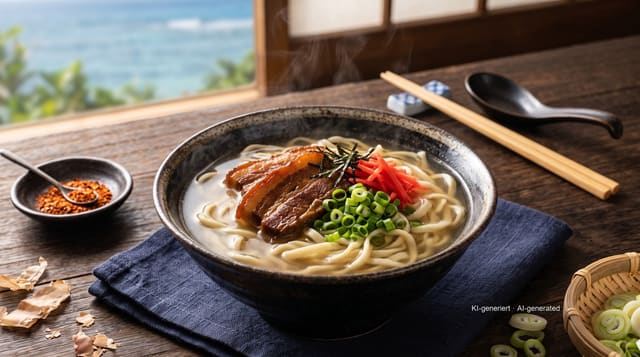
Okinawa-Soba — Noodle Soup with Pork Belly

Culinse · 30 min