JapaneseChubuMain courseLactose-free
Toyama BlackBlack Shoyu-Ramen
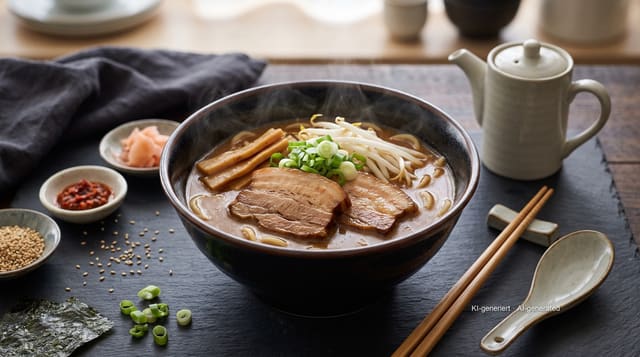
A Japanese classic from Chubu: these ramen come from the city of Toyama, and their broth is so dark that they became known by the name Toyama Black. Unlike Tokyo-style Shoyu-Ramen, the broth here is almost black from reduced soy sauce, powerfully salty and full of coarsely ground black pepper — in Toyama it was cooked after the war for construction workers, who ate a bowl of rice with it. The black seasoning is reduced at home for this and contains alcohol, which cooks off during cooking.
45
minutes
4
servings
12
Ingredients

Instructions
Bring the mirin to the boil in a small pan and let it bubble so that the alcohol cooks off; the sharp smell above the pan becomes noticeably milder and sweetish.
Turn down the heat and stir in the soy sauce and sugar until the sugar has dissolved. Wipe the kombu with a damp cloth, put it in the pan and heat the sauce slowly. As soon as the first small bubbles rise at the edge of the pan, take out the kombu, because if it were boiled along with the sauce it would turn bitter.
Let the sauce simmer gently, uncovered, over a low heat until about a third has evaporated and it is dark and glossy; it should only bubble gently, otherwise the sugar will catch and the sauce will taste burnt. As it reduces, it smells strongly of caramelised soy sauce.
Pull the pan off the heat, sprinkle in the bonito flakes, push them under briefly and leave them to steep until they have soaked up the liquid — they give the seasoning a smoky, deep flavour.
Pour the sauce through a fine sieve into a bowl and just let the flakes drain without squeezing them. This is the black tare: deep dark, glossy and powerfully salty, about 8 tbsp.
Slowly heat the tori-chintan in a pot until it steams and keep it hot over a low heat without letting it bubble, so that it stays clear. Put a large pot of plenty of unsalted water on to boil for the noodles and slice the spring onions into fine rings.
Put the chashu slices into the hot broth for 30 seconds until the fat shimmers translucently and the meat is warm, then lift them out and set them aside.
Fill four large bowls with hot water, leave them to stand briefly and pour the water out so that the broth stays hot in them for a long time. Put 2 tbsp black tare in each bowl; no aroma oil goes in here, because the soy sauce and pepper alone should set the tone.
Add the noodles to the rapidly boiling water, loosen them with chopsticks and cook for 3 to 4 minutes until done but still firm to the bite; dried ones according to the packet instructions. Shake them hard in the sieve until hardly any water drips from them, so that no cooking water dilutes the broth.
Divide the hot broth between the bowls, just under 400 ml each, and stir it into the tare — the golden broth turns a deep dark brown, almost black.
Add the noodles, lift them once with chopsticks and lay them back down neatly so that they sit loosely in the dark broth and do not stick together in a clump.
Arrange two slices of chashu, 2 tbsp menma and a small heap of spring onion rings in groups on top of each bowl and sprinkle everything generously with the pepper, about half a teaspoon per bowl. Spoon the warm rice into four small bowls, set them next to the ramen and serve everything immediately.
Edited by Peter Hölzer, head chef and master butcher
Similar recipes

Culinse · 45 min
Takayama-Ramen with Thin Wavy Noodles

Culinse · 70 min
Tsubame-Sanjo-style Seabura-Ramen

Culinse · 70 min
Hoto — Yamanashi-style Noodle Stew with Pumpkin and Miso

Culinse · 10 min
Nagoya-style Ogura Toast — Toast with Bean Paste and Butter or Margarine

Culinse · 25 min
Fukui-style Oroshi Soba — Cold Soba with Grated Daikon

Culinse · 35 min
Nagoya-style Taiwan-Ramen

Culinse · 45 min
Tebasaki — Crispy Nagoya-style Chicken Wings
Culinse · 45 min