NikumanSteamed Yeast Buns with Pork Filling
A Japanese classic sold all over Japan in winter from the steaming display case next to the till of every konbini: nikuman are snow-white, soft yeast buns, twisted together at the top in fine pleats, that enclose a juicy filling of minced pork, shiitake, onion and ginger. According to tradition, the buns have their roots in Chinese baozi; in Kansai they are called butaman and are often eaten with hot mustard. The filling contains a splash of sake and therefore alcohol, most of which evaporates during steaming.
60
minutes
4
servings
19
Ingredients

Instructions
Mix the flour, the sugar for the dough, the dried yeast, baking powder and salt in a bowl. Pour in the lukewarm water and the oil, stir everything with a spoon into rough flakes and then knead with your hands until you have a smooth, silky dough that feels as soft as an earlobe and no longer sticks to your fingers.
Shape the dough into a ball, return it to the bowl, cover and leave to rise in a warm place until roughly doubled in size. A floured finger pressed into it will then leave a hole that does not close up again.
Meanwhile, for the filling, peel the onion and chop it very finely. Cut the tough stalks off the shiitake, finely chop the caps as well, and peel and finely grate the ginger: the finer everything is, the smoother and juicier the filling will be, and nothing will poke through the thin dough later.
Put the mince in a bowl with the soy sauce, sake, oyster sauce, sugar for the filling, sesame oil, cornflour and pepper and knead vigorously by hand until the mixture turns pale and clings stickily to your fingers; this way it binds and stays juicy after steaming. Mix in the onion, shiitake and ginger, divide the filling into eight equal portions of about 60 g and chill until you fill the buns, as it is easier to wrap when cold.
Cut eight squares of baking paper of about 10 cm. Knead the dough briefly to press out the large gas bubbles, shape it into a log and cut it into eight equal pieces of about 65 g. Roll each piece into a smooth ball and keep the balls covered so that they do not dry out.
Roll out one ball on the lightly floured work surface into a circle of about 12 cm, rolling only the edge thinner and leaving the centre a little thicker. The thick centre later carries the weight of the filling and does not tear at the base, while the thin edge is folded into pleats and does not form a thick, chewy knot of dough at the top.
Place a portion of filling in the centre, hold the dough in the palm of your hand and, with the thumb and index finger of your other hand, draw the edge upwards in small pleats, turning the bun a little after each pleat. Once the pleats go all the way round, pinch them firmly together at the top and give them a slight twist so that the bun is tightly sealed. Set the bun on a square of baking paper and shape the rest in the same way.
Cover the buns with a cloth and leave them to rise again until they have visibly puffed up and feel soft and airy. Meanwhile, bring plenty of water to the boil in the pot beneath the steamer insert.
Set the buns on their paper in the steamer insert about 3 cm apart, as they will rise noticeably again during steaming; a two-tier bamboo steamer holds them all at once, otherwise steam them in two batches. Wrap the lid in a tea towel and knot the corners on top so that nothing hangs down onto the hot hob or into the flame: the cloth catches the steam, which would otherwise drip onto the buns.
Set the insert on the pot of rapidly boiling water, cover with the lid and steam the buns over a high heat without lifting the lid.
Switch off the hob and wait a minute before carefully removing the lid, so that the steam does not escape all at once and the dough stays smooth; keep your face away from the rising steam. Cut one bun open to check: the filling must be grey all the way through with no pink spots, the juices must run clear and a thermometer should read 70 °C at the core; otherwise steam for another 3 minutes.
Serve the nikuman hot on their paper, which is only peeled off as you eat, and put the hot mustard alongside in a small bowl. A small dab on each bite cuts pleasantly through the slightly sweet, juicy filling.
Edited by Peter Hölzer, head chef and master butcher
Similar recipes

Culinse · 45 min
Onigiri — Rice Balls with Three Fillings

Culinse · 35 min
Goya Champuru — Okinawa-style Bitter Melon with Tofu and Egg
Culinse · 50 min
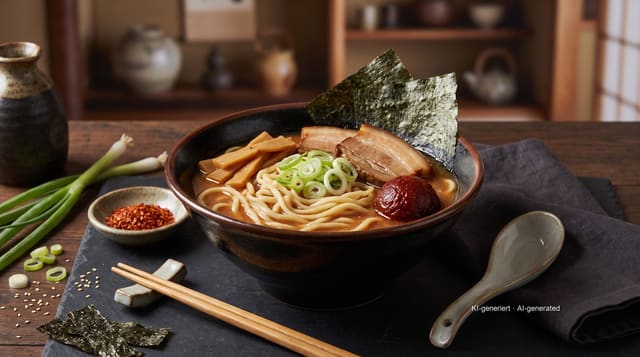
Akayu-Ramen with a Spicy Miso Ball

Culinse · 50 min
Tokushima-Ramen with Sweet Braised Pork Belly

Culinse · 30 min
Unadon — Glazed Eel on Rice

Culinse · 35 min
Tsuruga-Ramen — Fukui-style Tonkotsu-Shoyu from the Street Stall

Culinse · 55 min
Curry-Tsukemen — Dipping Ramen with Curry Broth

Culinse · 15 min