OnigiriRice Balls with Three Fillings
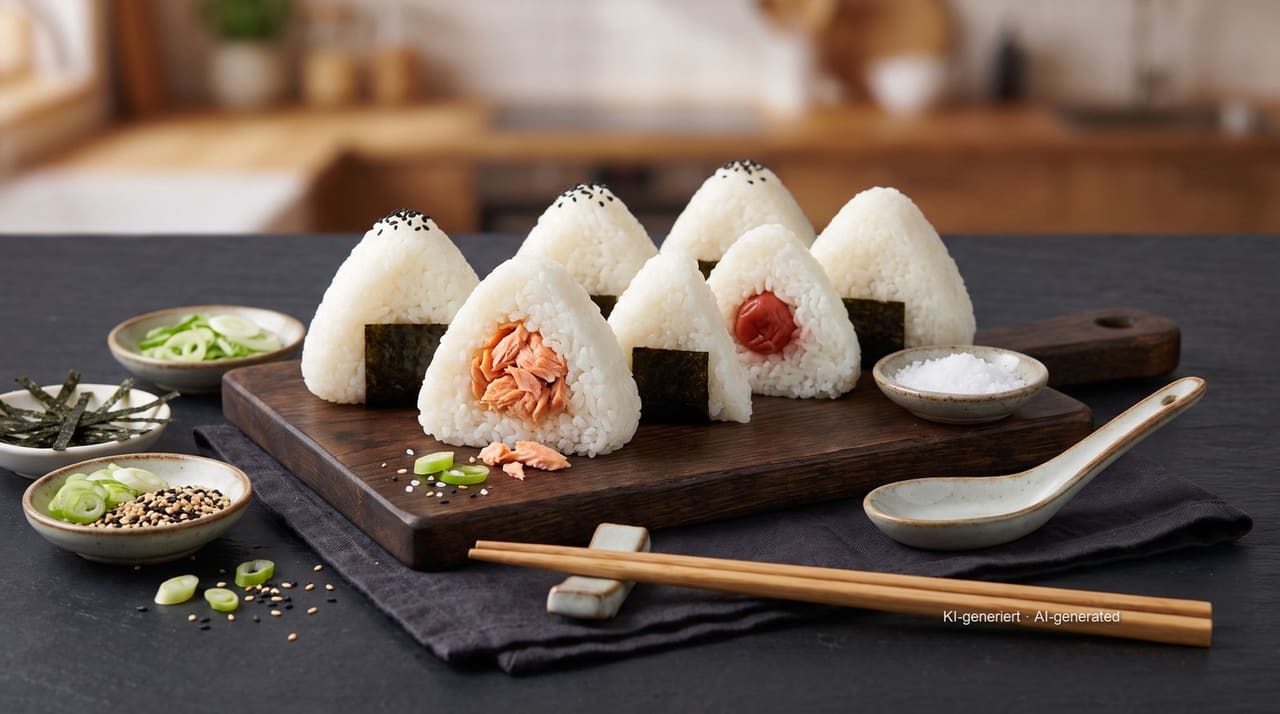
A Japanese classic that belongs in every bento box, every picnic basket and every little corner shop all over Japan: onigiri, in many places also called omusubi, are triangular rice balls, lightly salted on the outside and with a strip of nori to hold them by. Here they come with three of the most popular fillings — pan-fried salted salmon, sour and salty pickled plum and creamy canned tuna with mayonnaise. The warm rice is pressed only firmly enough to hold together in the hand and fall apart loosely in the mouth.
45
minutes
4
servings
10
Ingredients
Instructions
Cook the rice following the basic recipe so that it has finished resting by the time the fillings are ready, and keep it warm in the closed pot. Onigiri are shaped from warm rice, because only then do the grains stick together — cold rice crumbles in your hand.
Pat the salmon fillet dry, feel for bones with your fingers and pull them out with tweezers. Rub the salmon all over with the salt for the salmon and leave it until fine droplets appear: the salt draws out water, firms the flesh and seasons it right through — a small-scale version of the salted salmon (shiozake) that is sold ready-made in Japan.
Pat the salmon with kitchen paper and fry it in a non-stick frying pan without any fat over a medium heat, skin side or smooth side down first, turning it halfway through. It is cooked when the flesh is pale pink and opaque all the way through and comes apart in flakes with a fork; the core temperature is then 62 to 65 °C.
Leave the salmon to cool briefly, peel off the skin and pull the flesh apart into small flakes with two forks, watching out for any bones you missed.
Press the pickled plums open with your fingers, remove the stones and set aside a small piece of each plum for garnishing. Finely chop the remaining flesh until you have a red paste with a strong sour and salty smell.
Drain the tuna well in a sieve, mash it finely with a fork and stir it together with the mayonnaise and soy sauce into a creamy but not runny mixture. If the filling is too wet, it softens the rice from the inside and the onigiri falls apart.
Cut each nori sheet with dry scissors into four strips of equal width, to make 12 strips. Nori absorbs moisture immediately and then turns soft and chewy, so keep the strips ready on a dry plate, not next to the bowl of water.
Put a bowl of cold water next to the rice, with the salt for your hands on a small plate. Dip your hands in the water, shake them lightly and rub a good pinch of salt between your palms: the water stops the rice sticking to your fingers, and the salt seasons the outside.
Put about 75 g warm rice, a good handful, in your palm, press it lightly flat and press a hollow into the centre with your thumb. Put in a heaped teaspoon of filling and close the rice over it from all sides so that the filling disappears completely.
To shape it into a triangle: your upper hand forms a roof with the fingers held together and bent at the knuckles, while your lower hand holds the rice in its cupped palm. Press together gently, turn the onigiri a third of a turn and press again, until after three turns you have a triangle with rounded corners. It should be smooth and firm on the outside and loose inside — rice pressed too firmly turns into a solid lump.
Moisten and salt your hands again before each onigiri and shape all 12 in this way: four with salmon, four with pickled plum and four with tuna mayonnaise.
Wrap a strip of nori around the base of each onigiri so that it reaches from the front, over the bottom edge, onto the back; this way it can be picked up without your fingers sticking. To tell them apart, sprinkle the salmon onigiri with sesame seeds on top and set the reserved piece of umeboshi on the plum onigiri; the tuna onigiri stay plain.
Edited by Peter Hölzer, head chef and master butcher
Similar recipes

Culinse · 170 min
Kakuni-Don — Nagasaki-style Braised Pork Belly on Rice

Culinse · 60 min
Kyoto-style Kotteri-Ramen

Culinse · 45 min
Bang Bang Ji — Japanese-Chinese Chicken with Sesame Sauce

Culinse · 35 min
Sobameshi — Kobe-style Fried Rice with Yakisoba

Culinse · 30 min
Nasu no Nibitashi — Aubergine in Dashi Broth

Culinse · 35 min
Hachioji-Ramen with Diced Onions and Lard

Culinse · 55 min
Yosenabe — Colourful Hotpot with Fish, Chicken and Vegetables

Culinse · 20 min