JapaneseShikokuSide dishVegetarianVegan
Sanuki-UdonHomemade Thick Wheat Noodles
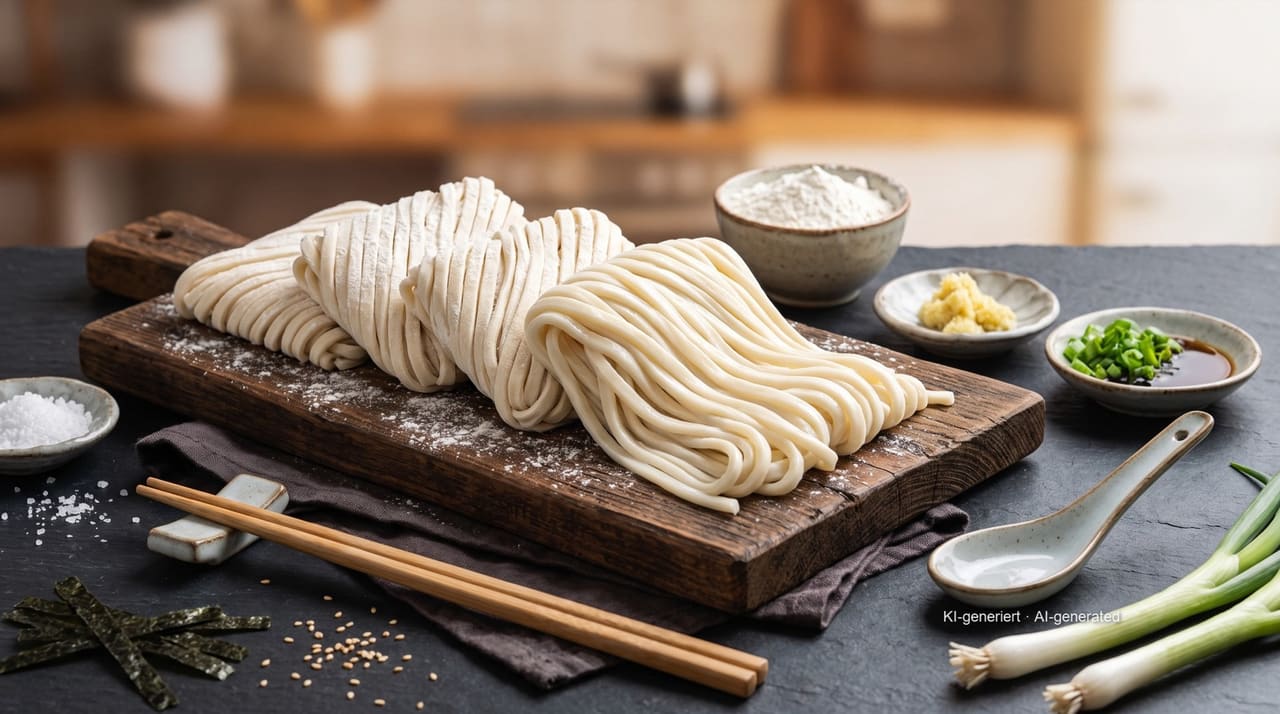
A Japanese classic from Shikoku: Kagawa Prefecture, formerly called Sanuki, is regarded in Japan as the udon country par excellence, and there the dough is traditionally kneaded with the feet inside a bag. The noodles turn out thick, glossy and square-edged and have a firm, springy bite, which is called koshi in Japan. Serves 4.
52
minutes
4
servings
4
Ingredients
Instructions
Stir the salt into the water until all the crystals have dissolved and nothing crunches at the bottom any more. The salt water strengthens the gluten in the dough and later makes the noodles elastic and firm to the bite.
Put the flour in a large bowl, pour in the salt water in three portions and each time rub it quickly into the flour with your fingertips. The result is a crumbly dough that looks like coarse crumble topping. Do not add any more water: the dough is deliberately dry, as this is the only way the noodles turn out firm.
Press the crumbs firmly together into a lump with both hands and knead vigorously with the heel of your hand until everything holds together. The dough will still be rough and cracked at this stage; it only becomes smooth when it is trodden.
Put the dough in a sturdy freezer bag, press out the air, seal the bag and wrap it in a clean tea towel. Lay it on the floor and, with clean feet, tread it flat in small steps from the centre outwards until the dough is about 1 cm thick. Without treading, it can also be done on the work surface with your fists and the heels of your hands; it just takes more strength.
Take the dough out of the bag, fold it in from two sides to the centre, put it back in the bag and tread it flat again. Repeat the folding and treading ten times in all, until the surface is smooth with a silky sheen and the dough feels firm and elastic.
Shape the dough into a smooth ball and leave it to rest in the sealed bag, in the fridge in summer. During this time the gluten relaxes and the dough can be rolled out without springing back.
Dust the work surface thinly with cornflour and roll the dough out with a rolling pin into a rectangle 3 mm thick. Keep turning it and dusting it again so that nothing sticks, and make sure the thickness is even, as thin areas cook faster than thick ones.
Dust the sheet of dough generously with cornflour and fold it loosely into three layers. Cut it into strips 3 to 4 mm wide with a large, sharp knife, pressing the knife down and forwards in one movement rather than sawing, so that the edges stay sharp and the noodles are almost square in cross-section.
Immediately shake the strips apart, dust them with the remaining cornflour and divide them loosely into four portions so that nothing sticks together.
Bring at least 4 litres of unsalted water to a rolling boil in a large pot; the dough is already well salted and releases its salt into the water as it cooks. Tap the noodles lightly so that excess starch falls off, add them to the water and stir immediately with chopsticks so that they do not stick to the bottom.
Boil over a high heat, turning the heat down only briefly if the water foams up too high. The noodles are done when they look glossy and translucent and a noodle cut in half no longer has a white core in the centre; otherwise cook them for another 1 to 2 minutes.
Tip the noodles into a sieve, put them in a bowl of cold water and rub them vigorously with your hands under cold running water until they no longer feel slippery. This rinses the starch off the surface, and the cold water firms up the noodles — only now do they get their typical bite.
For cold dishes, drain the noodles well and serve immediately. For hot soups, dip the portions into boiling water in the sieve for 30 seconds until they are hot all the way through, shake them well and put them straight into the hot broth.
Edited by Peter Hölzer, head chef and master butcher
Similar recipes

Culinse · 25 min
Sanuki-style Kamaage-Udon — Udon Hot from the Pot with Dipping Sauce

Culinse · 40 min
Kitsune-Udon — Udon with Sweet Simmered Tofu

Culinse · 20 min
Mentsuyu — The Seasoning Sauce for Udon and Soba

Culinse · 25 min
Ise-Udon — Ise-style Soft Udon with Dark Tare

Culinse · 40 min
Susaki-style Nabeyaki-Ramen

Culinse · 50 min
Tokushima-Ramen with Sweet Braised Pork Belly

Culinse · 35 min
Kochi-style Katsuo no Tataki — Flame-seared Bonito with Ponzu

Culinse · 70 min