JapaneseKansaiDessertVegetarianVegan
Nama-YatsuhashiSoft Kyoto-style Cinnamon Mochi Triangles
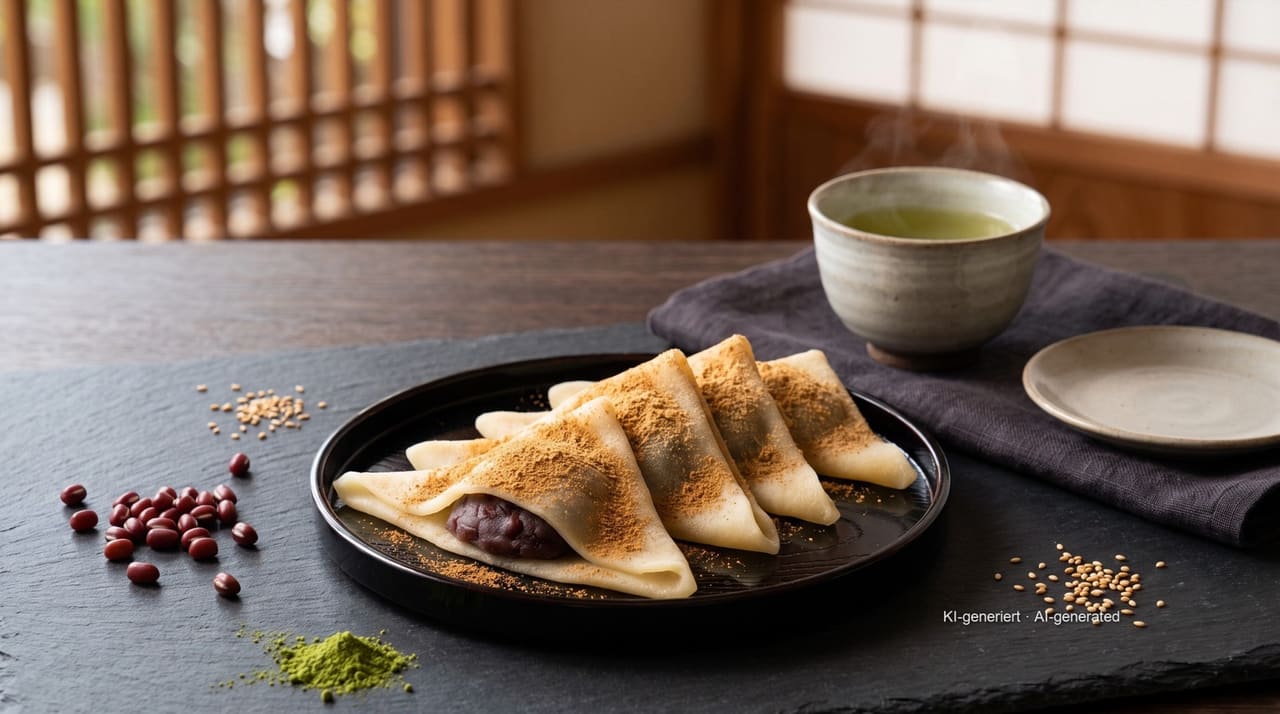
A Japanese classic from Kansai: Nama-Yatsuhashi belong to the wagashi, the traditional Japanese sweets, and consist of a soft, unbaked dough of rice flour and glutinous rice flour folded around a dollop of sweet red bean paste. Unlike Daifuku — Mochi with Sweet Bean Filling, the dough here is wafer-thin, fragrant with cinnamon and folded into a triangle — Kyoto's classic souvenir, which according to tradition is named after a musician who worked in the city. The dough cooks in a few minutes in the microwave, is rolled out on roasted soybean flour (kinako) and tastes velvety, slightly chewy and nutty and spicy.
35
minutes
4
servings
8
Ingredients
Instructions
Mix the rice flour, glutinous rice flour and sugar in a large microwave-safe bowl. Gradually stir in the water with a silicone spatula and keep stirring thoroughly until even the small granules of glutinous rice flour have dissolved and you have a smooth, milky-white batter with no lumps.
Cover the bowl loosely with cling film and cook the batter in the microwave at 600 watts; afterwards it will already be firm at the edge and still liquid in the middle.
Stir the dough vigorously with a wet silicone spatula until it is even, cover again and continue cooking until it is glossy throughout, looks slightly translucent and no longer has any white, floury patches.
If floury patches are still visible, stir the dough and cook for another 30 seconds. Sprinkle over the cinnamon for the dough and knead it in vigorously with the wet spatula, pressing the hot dough against the side of the bowl and folding it over again and again until it is evenly light brown, smells of cinnamon and becomes smooth and elastic.
Dust the work surface thickly with about half of the kinako, as the hot dough is very sticky. Slide the dough onto it with the spatula, halve it with a dusted dough scraper and dust the top with kinako as well. Let it steam briefly until you can handle it, but do not let it cool down, as cold dough can hardly be rolled out.
Roll out each half of the dough with a kinako-dusted rolling pin into a rectangle of about 25 × 17 cm and about 3 mm thick, sprinkling a little kinako underneath and on top again and again so that nothing sticks. The more even and thin the dough, the more delicate the triangles will be.
Trim the edges straight with a sharp, kinako-dusted knife to make rectangles of 24 × 16 cm, and divide each rectangle into 6 squares of 8 cm. Brush excess kinako off the top with a dry brush so that the edges stick together when folded.
Place 1 tsp anko (about 10 g) in a slightly elongated mound in the centre of each square. Fold the square diagonally into a triangle and gently press the edges together to the left and right of the filling so that the bean paste is sealed in.
Mix the remaining kinako with the cinnamon for dusting and dust the triangles lightly with it through a small sieve. Arrange the Nama-Yatsuhashi on a plate and serve the same day with green tea, while the dough is still velvety soft.
Edited by Peter Hölzer, head chef and master butcher
Similar recipes
Culinse · 35 min
Kansai-style Ozoni — New Year's Soup with White Miso and Mochi

Culinse · 45 min
Wakayama-Ramen with Tonkotsu-Shoyu Broth

Culinse · 25 min
Ise-Udon — Ise-style Soft Udon with Dark Tare

Culinse · 50 min
Shabu-Shabu — Beef in Kombu Broth with Two Sauces

Culinse · 50 min
Osaka-style Okonomiyaki — Savoury Cabbage Pancake

Culinse · 65 min
Kyoto-style Nishin Soba — Soba with Sweet Simmered Herring

Culinse · 30 min
Kyoto-style Cod in Miso Marinade — Saikyo-yaki

Culinse · 25 min