JapaneseKantoMain courseLactose-free
TanmenTokyo-style Shio-Ramen with Stir-fried Vegetables
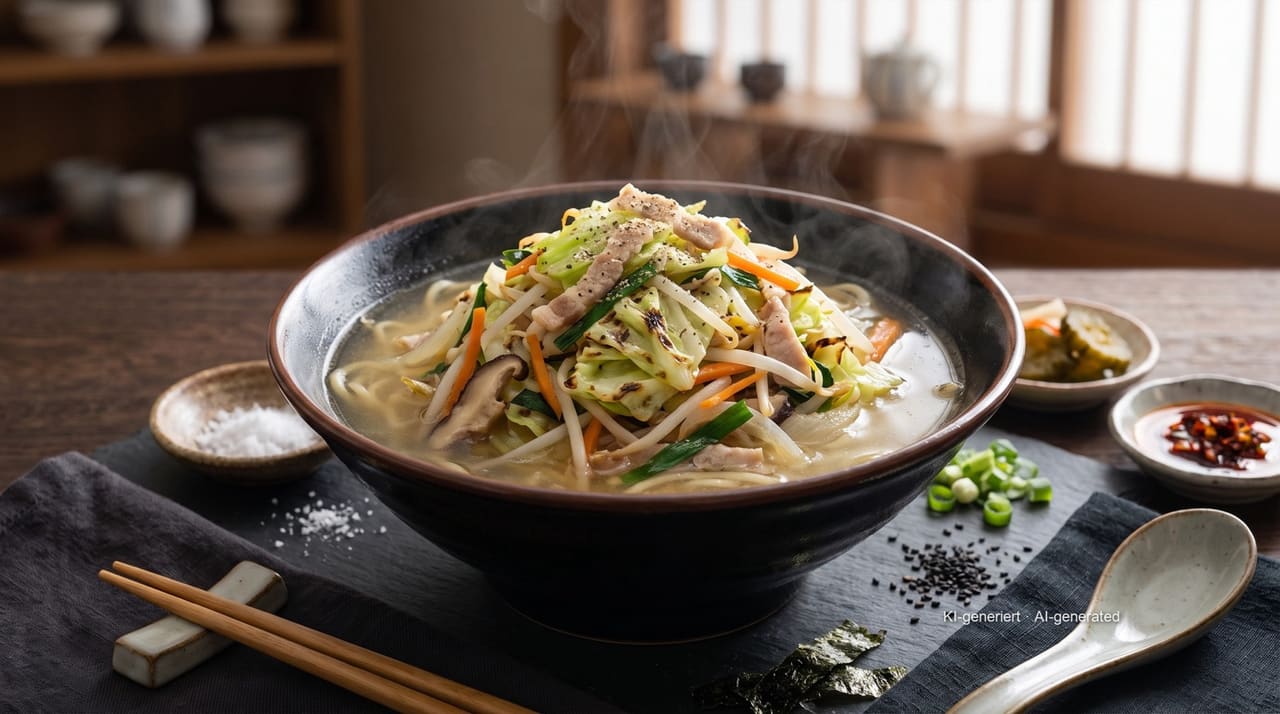
A Japanese classic from Kanto: tanmen is found almost only in this region, but in Tokyo it is served in nearly every noodle shop — a pale golden salt broth with thick noodles under a mountain of white cabbage, bean sprouts, carrot, mushrooms and pork. Unlike Hakodate-style Shio-Ramen, the vegetables here are first stir-fried over a high heat in the wok and then briefly cooked in the broth, so that the clear salt broth takes on their flavour. The soup tastes mild and slightly sweet of cabbage, a little smoky from the wok, and the pepper gives it a subtle heat.
40
minutes
4
servings
14
Ingredients
Instructions
Heat the Tori-Chintan slowly in a pan until it steams and keep it hot over a low heat without letting it boil. Put a second, large pan of plenty of unsalted water on to boil for the noodles. The broth must go into the wok hot, because cold broth would cool down the stir-fry and make the vegetables watery.
Heat a wok or a wide, heavy pan over a high heat until hot, add the sesame oil and stir-fry the strips of pork shoulder until browned all over with no pink visible any more. Because it is cut so thinly, the meat is then cooked through and has reached 70 °C at the core.
Add the garlic, ginger, onion, carrot and shiitake, then the white cabbage, and stir-fry everything over a high heat, turning constantly, until the cabbage wilts, turns translucent at the edges and takes on a little colour. This fierce frying produces the smoky wok aroma that the broth will later take on.
Add the bean sprouts and the garlic chives (or spring onions), cut into 3 cm lengths, and toss only briefly until the sprouts are glossy but still crunchy.
Pour in the hot Tori-Chintan — it hisses fiercely and the browned bits come away from the bottom. Bring to the boil once and simmer gently over a medium heat until the vegetables are just tender and the pale golden broth smells of cabbage and mushrooms.
Stir in the Shio-Tare and pepper and season the soup to taste; the tare only goes in now because the broth reduces a little as it simmers, and this way the saltiness can be adjusted precisely. Keep the soup warm over the lowest heat without boiling it any further, so that the cabbage does not fall apart.
Fill four large bowls with hot water, leave them to stand briefly and pour the water away — in a warmed bowl the soup stays hot to the last spoonful. The bowls need no tare or oil here; all the seasoning is already in the soup.
Loosen the noodles with chopsticks in the rapidly boiling water and cook them: fresh thick noodles for about 3 minutes, dried ones according to the packet instructions. Shake them well in the sieve until hardly any water drips, so that no cooking water dilutes the soup.
Ladle the hot broth into the bowls, leaving the meat and vegetables in the wok for now.
Add the noodles, lift them once with chopsticks and lay them back down neatly so that they sit loosely in the broth and do not stick together.
Pile the vegetables and meat on top in a tall mountain with a slotted spoon and serve the tanmen immediately, while the cabbage still has a slight bite.
Edited by Peter Hölzer, head chef and master butcher
Similar recipes

Culinse · 35 min
Fukagawa-Meshi — Tokyo-style Rice with Clams
Culinse · 45 min
Monjayaki — Tokyo-style Runny Cabbage Pancake

Culinse · 40 min
Katsuura-Tantanmen with Onions and Chilli Oil

Culinse · 55 min
Wantan-men — Tokyo-style Shoyu-Ramen with Prawn Wantan

Culinse · 35 min
Hiroshima-style Shirunashi Tantanmen — Tantanmen without Broth

Culinse · 45 min
Hiyashi Tantanmen — Cold Tantanmen for Summer

Culinse · 45 min
Hosomaki — Thin Sushi Rolls with Cucumber and Tuna
Culinse · 35 min