ChineseGuangdongBasic recipeVegetarianVegan
Homemade Ho FunWide Rice Noodle Sheets from the Steamer
A basic Chinese recipe from Guangdong: Ho Fun, in Canton also called Shahe Fen after the district of Shahe, are wide, smooth ribbon rice noodles which are steamed sheet by sheet from a thin rice batter in a flat tin and then cut into ribbons. Fresh, they are soft, silky and slightly elastic with a mild taste of rice; the batter rests for half an hour beforehand, after which each sheet steams for only 5 minutes. They are needed for Ganchao Niuhe — fried rice noodles with beef, the test of Cantonese wok cooking, and in a bowl of Qing Tang — clear chicken broth as a basic stock they become a simple noodle soup.
60
minutes
4
servings
7
Ingredients

Instructions
Mix the rice flour, tapioca starch, cornflour and salt in a bowl. Stir in the water a little at a time with a whisk until a smooth batter without lumps forms, as thin as milk, and stir in 1 tbsp oil at the end.
Leave the batter to rest, covered, so that the flour swells and the noodles later become smooth and supple.
Bring about 5 cm of water to a rolling boil in a wok or wide pot with a lid and set in a steaming rack on which the tin will sit flat. Brush a flat, square metal baking tin of about 20 cm side length thinly with oil; have a bowl of cold water, oven gloves, a dough scraper and an oiled tray ready beside it. Work as in recipe Liangpi Sheets and Mianjin — Washed Wheat Dough in the Shaanxi Style, only a little thicker.
Stir the batter vigorously from the bottom, because the starch settles quickly, and pour a ladleful (about 110 ml) into the tin; swirl the tin until the base is evenly covered to a depth of about 3 mm. Set the tin on the rack over the rapidly boiling water, put the lid on and steam until the sheet is translucent and throws up large bubbles.
Lift the lid away from you, as hot steam escapes, take the tin out with oven gloves and set it in the cold water, without water running onto the sheet, until it has cooled. Brush the top of the sheet thinly with oil, loosen it from the edge with the dough scraper and pull it whole onto the oiled tray.
The first sheet is a trial sheet: if it is thick and tough, use a little less batter next time or thin the batter with 1 to 2 tbsp water; if it stays whitish and sticky, steam for 1 minute longer. Grease the tin afresh each time and steam further sheets from the remaining batter in the same way, until about 6 sheets lie on top of one another with the oiled side up. With two tins it goes faster, because one steams while the other cools.
Leave the sheets to cool until only lukewarm, fold each loosely twice and cut crossways with an oiled knife into ribbons 1.5 to 2 cm wide. Carefully separate the ribbons with lightly oiled fingers, put them loosely on a plate and keep them covered at room temperature until needed.
Edited by Peter Hölzer, head chef and master butcher
Similar recipes

Culinse · 100 min
Cantonese Tang Nian Gao — Sweet Sticky Rice Cake for New Year

Culinse · 52 min
Biangbiang Noodles — Wide Ribbon Noodles from Shaanxi

Culinse · 10 min
Char Siu Marinade — Honey Glaze for Cantonese Barbecued Meat
Culinse · 75 min
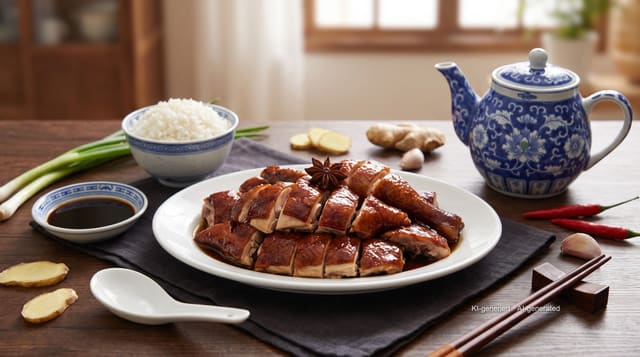
Chiyou Ji — Soy Sauce Chicken Cantonese Style

Culinse · 110 min
Lo Bak Go — Pan-Fried Turnip Cake

Culinse · 14 min
Suanrong Kongxincai — Water Spinach with Garlic

Culinse · 115 min
Yu Pian Zhou — Congee with Sliced Fish

Culinse · 45 min