Seasoning a WokSeasoning a Steel Wok with Oil and Spring Onions
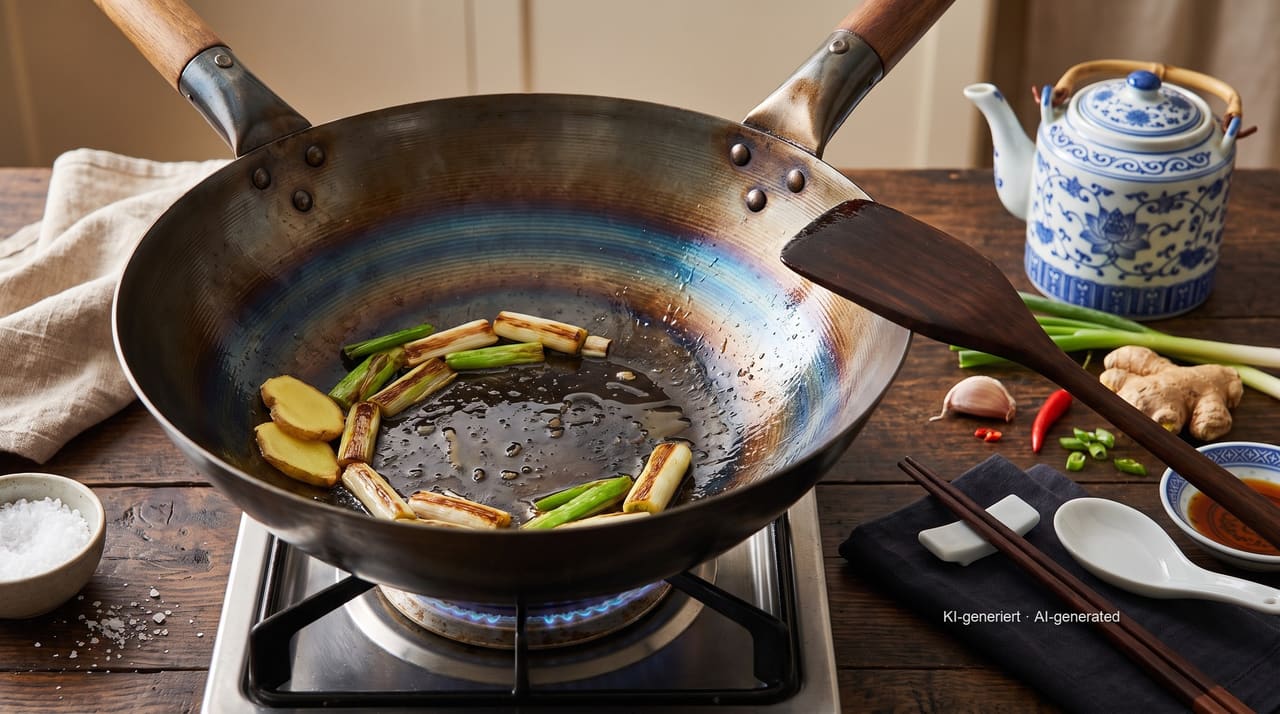
A basic Chinese recipe used all over China: Kai Guo, literally opening the wok, is the name for seasoning a new, uncoated carbon steel wok, which turns blue-bronze and with oil, spring onions and ginger gets a first dark, smooth protective layer. With every use it becomes darker and slicker, and only a wok prepared in this way gives dishes such as Yangzhou Chaofan — fried rice Yangzhou style, Qingchao Xiaobaicai — stir-fried pak choi with garlic and Sichuan-Style Gongbao Jiding — chicken with peanuts and dried chillies the smoky fragrance of great heat. Makes one seasoned wok.
60
minutes
1
servings
5
Ingredients
Instructions
Remove the stickers and wash the wok thoroughly inside and out with hot water, washing-up liquid and a scouring sponge until the protective factory oil has been completely removed; if the wok has a protective lacquer, remove it following the manufacturer's instructions. Rinse well and dry.
Before heating, turn the extractor fan to its highest setting, open the window and keep children out of the kitchen, because it smokes heavily. Have thick oven gloves ready, because even a metal handle gets hot, and never leave the wok unattended during the whole seasoning.
Heat the wok over the largest gas flame or the strongest hob ring until the steel turns blue-bronze at the base. Then tilt the wok with oven gloves and turn it slowly, so that bit by bit the whole inner surface up to the rim changes colour; on induction use only woks with a flat base, where mainly the base changes colour.
Switch off the heat and leave the wok to cool on the hob until it is only warm; never refresh it with cold water, because the steel can warp.
Meanwhile, trim the spring onions and cut them into 5 cm lengths, cut the unpeeled ginger into thick slices and pat everything thoroughly dry, because water spits in hot oil. Rub 1 tbsp oil thinly over the whole inner surface of the warm wok with kitchen paper.
Put another 3 tbsp oil into the wok and heat over a medium heat until it shimmers, then add the spring onions and ginger. Push and press them vigorously with the wok spatula over the whole inner wall up to the rim, so that oil and aromatics soak in everywhere, until the spring onions and ginger are blackish brown.
Throw away the spring onions and ginger and put the salt into the still warm wok. Scour vigorously with scrunched-up kitchen paper, held with kitchen tongs, so that charred remains come off, then throw the salt away.
Rinse the wok out with hot water and a soft brush, dry it on the hob over a medium heat until no water can be seen any more, and rub it wafer-thin with the last 1 tbsp oil. The inner surface is now dark and flecked golden brown and shines lightly.
To care for it, clean the wok after each use only with hot water and a brush, dry it at once on the hob and oil it thinly. Do not soak it, do not put it in the dishwasher and do not leave acidic food standing in it; rub rust off with coarse salt and a scouring sponge and season the spot again as described.
Edited by Peter Hölzer, head chef and master butcher
Similar recipes

Culinse · 40 min
Sichuan-Style Chilli Oil — Hongyou with Sichuan Pepper and Sesame

Culinse · 36 min
Black Sesame Filling — for Ningbo-Style Tangyuan

Culinse · 230 min
Lanzhou-Style Beef Broth — for Beef Noodle Soup

Culinse · 40 min
Doujiang — Homemade Soy Milk

Culinse · 50 min
Leshan-Style Bangbang Ji — Cold Chicken with Sesame and Chilli Sauce

Culinse · 115 min
Jianshui Mian — Yellow Alkaline Noodles for Reganmian and Dan Dan Mian

Culinse · 80 min
Suanni Bairou — Cold Pork Belly with Garlic and Chilli Sauce

Culinse · 30 min