PortugueseAlentejoSide dishVegetarianVegan
Pão alentejanoWheat Sourdough Bread with a Dense Crumb
A Portuguese classic from the Alentejo (Évora): Pão alentejano is a large, round wheat bread made with sourdough, often with a small cap of dough on top, a thick, floury crust and a dense, fine-textured, slightly sour crumb. Precisely because it is so firm, it stays fresh for days and later soaks up soups and bread dishes without falling apart. The dough needs nothing but flour, water, salt, sourdough and plenty of time.
85
minutes
12
servings
4
Ingredients

Instructions
The evening before, make the pre-ferment: stir the starter with 100 g flour and 100 ml water in a bowl until smooth, cover and leave to ripen overnight at room temperature for 10 to 12 hours until very bubbly and sour-smelling.
The next day, mix the remaining 600 g flour, 360 ml water and the pre-ferment in a large bowl just until no dry flour is visible, and leave to rest, covered.
Add the salt and knead the dough vigorously in a stand mixer or by hand until smooth, elastic and barely sticky; by hand this takes a good 15 minutes.
Leave the dough to rise, covered, at room temperature, stretching and folding it twice during the first hour: pull one side of the dough up, lay it over the middle and repeat all the way round. By the end the dough should have risen noticeably and be domed.
Turn the dough out onto a floured work surface, take off about 50 g for the cap and shape the rest tightly into a round ball. Roll the small piece into a ball, flatten it, place it in the centre of the loaf with a little water and press it firmly in the middle with a floured thumb.
Place the loaf cap side down in a well-floured bowl lined with a cloth, cover and leave to prove until visibly risen and a fingertip dent springs back only slowly.
Preheat the oven to 250°C top and bottom heat with a baking tray on the bottom shelf and an ovenproof dish on the oven floor.
Turn the loaf out onto a piece of baking paper so that the cap is on top, slide it on the paper onto the hot tray, pour about 100 ml hot water from the kettle into the dish and close the door immediately. Bake the bread at 250°C to start.
Briefly open the oven door to let the steam escape, lower the temperature to 220°C top and bottom heat and finish baking the bread until the crust is deep brown and it sounds hollow when tapped on the bottom.
Leave the bread to cool completely on a wire rack before slicing so that the crumb firms up.
Edited by Peter Hölzer, head chef and master butcher
Similar recipes

Culinse · 25 min
Gaspacho alentejano — Cold Soup with Diced Tomatoes, Cucumber, Pepper, Bread and Oregano

Culinse · 100 min
Polvo de coentrada — Octopus in Coriander and Garlic Sauce over Toasted Bread
Culinse · 80 min
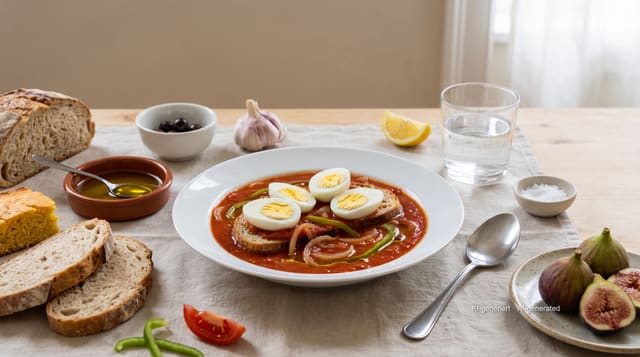
Sopa de tomate à alentejana — Tomato Soup with Onions, Egg and Bread

Culinse · 85 min
Carne de porco à alentejana — Pork with Clams, Diced Potatoes and Coriander

Culinse · 185 min
Azevias — Fried Half-Moons with a Sweet Chickpea Filling

Culinse · 30 min
Massa de pimentão — Fermented Red Pepper Paste with Salt

Culinse · 15 min
Pisado de alho e coentros — Garlic Pounded with Coriander, Salt and Olive Oil

Culinse · 146 min