JapaneseChugokuMain courseLactose-free
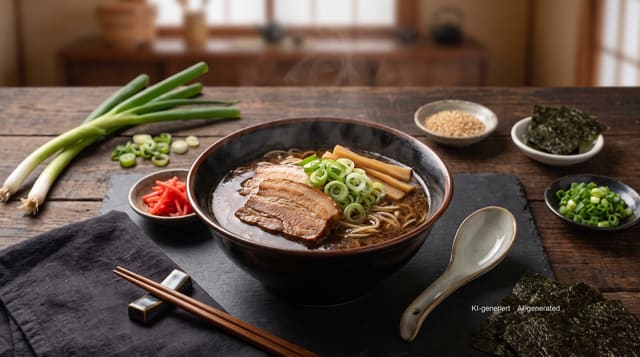
Gyukotsu-RamenTottori-style Beef Bone Ramen
A Japanese classic from Chugoku: in central and western Tottori Prefecture, around Kurayoshi and Yonago, the ramen shops make their broth from beef bones, and hardly anywhere else in Japan is this taken so much for granted. Unlike Hakata-style tonkotsu ramen, beef bones are simmered here instead of pork bones — the broth turns golden brown instead of white and tastes sweetish and deeply of beef, and there it has been the usual ramen for decades. The bones are first soaked for half an hour and then simmer for a good five hours, so it is best to start the day before or on a day off.
350
minutes
4
servings
14
Ingredients

Instructions
Put the beef bones in a large bowl, cover them with cold water and leave them to soak. The water draws blood out of the bones, which would otherwise make the broth grey and cloudy.
Drain the bones, put them in a large pot, cover with fresh cold water and bring to the boil. Let them boil hard until a thick, greyish-brown foam collects on top — this blanching removes the last traces of blood and the impurities that cloud the broth.
Drain the bones in a sieve, pour the water away and scrub each bone under running water until no dark residue clings to it. Rinse the pot thoroughly, because foam sticks to the side and would cloud the new broth.
Return the bones to the pot with the 4 l water and bring to the boil; skim off any foam that still rises with a slotted spoon. Turn the heat down a little and let the broth simmer vigorously, topping up the evaporated water again and again so that the bones are always covered.
Wash the onion and halve it with its skin on, because the skin colours the broth golden. Roughly chop the carrot, slice the ginger, crush the garlic with the flat of a knife and wash the leek greens thoroughly, because soil often hides between the leaves. Add everything to the broth and simmer without topping up any further until the broth is golden brown and slightly cloudy, smells deeply of beef and tastes sweetish even without seasoning.
Pour the broth through a fine sieve into a second pot; the bones and vegetables have given up their flavour. Skim some of the fat off the surface with a ladle, but leave a thin golden film, because it carries the beef flavour. From the roughly 2.4 l of broth, measure out 1.6 l for the four bowls, dissolve the sugar in it and keep it hot over a low heat.
Put a large pot with plenty of unsalted water on for the noodles. Slice the spring onions into fine rings and halve the nori sheets; keep both dry and within reach of the hob, because serving has to go quickly.
Lay the chashu slices in the hot broth for 30 seconds until the fat turns translucent and the meat is warm, then lift them out and set them ready.
Fill four large bowls with hot water, leave them to stand briefly and pour the water away — in a warmed bowl the broth stays hot to the last spoonful. Put 3 tbsp shoyu-tare in each bowl; no aroma oil is needed, because the film of beef fat on the broth provides fragrance and gloss.
Loosen the noodles with chopsticks in the rapidly boiling water and cook them: fresh noodles for 1 to 2 minutes, dried according to the packet. The noodles should still have a slight bite, because they continue to cook in the hot broth. Shake them vigorously in the sieve until hardly any water drips from them, so that no cooking water dilutes the broth.
Divide the hot broth between the four bowls and stir it into the tare until it is evenly amber brown and small golden beads of fat float on the surface.
Add the noodles, lift them once with chopsticks and lay them back down neatly so that they lie loosely in the broth and do not stick together in a lump.
Arrange the toppings in groups on top: 2 slices of chashu, 2 tbsp menma and a small heap of spring onion rings per bowl. Lean two pieces of nori against the rim of each bowl so that they do not go soggy straight away, and serve the ramen immediately.
Edited by Peter Hölzer, head chef and master butcher
Similar recipes
Culinse · 40 min
Ube-Ramen — Rich Yamaguchi-style Tonkotsu

Culinse · 45 min
Wakayama-Ramen with Tonkotsu-Shoyu Broth

Culinse · 75 min
Vegetarian Shoyu-Ramen with Shiitake-Dashi

Culinse · 80 min
Onomichi-Ramen with Anchovy Dashi

Culinse · 50 min
Dote-Nabe — Hiroshima-style Oyster Miso Hotpot

Culinse · 70 min
Hiroshima-style Okonomiyaki — Layered with Yakisoba

Culinse · 60 min
Kasaoka-Ramen with Chicken Chashu

Culinse · 35 min