JapaneseKansaiSnackLactose-free
KushikatsuOsaka-style Breaded Skewers
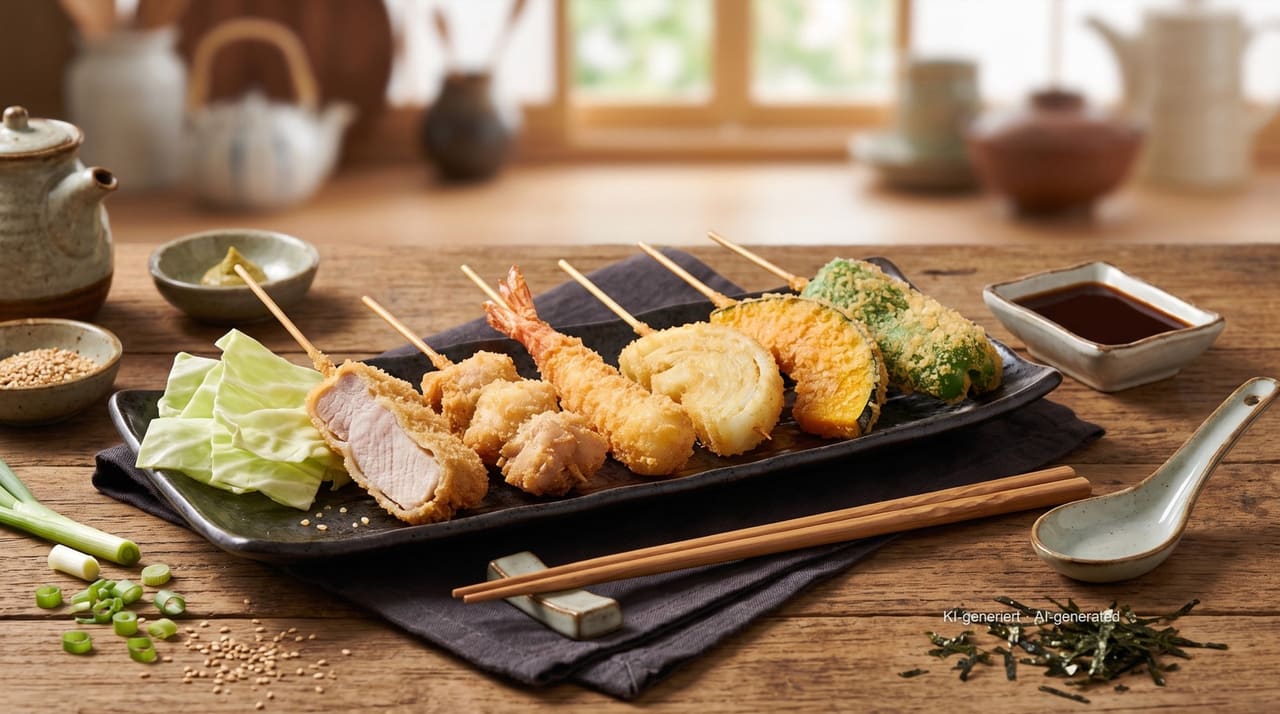
A Japanese classic from Kansai: in Osaka, especially in the old entertainment district of Shinsekai, there are rows of eateries where kushikatsu are handed over the counter fresh from the oil — small skewers of pork, chicken, prawns and vegetables in a fine, crisp panko coating. They are dipped into a thin, savoury sauce, and traditionally an iron rule has always applied: each skewer goes in only once, because all the guests at the counter share the same pot of sauce. Raw cabbage leaves on the side refresh the palate between skewers and also serve as a spoon for the sauce.
55
minutes
4
servings
18
Ingredients
Instructions
Cut the pork loin into 12 pieces of about 3 cm and the chicken into 12 pieces as well. Keep the chicken separate, and afterwards wash the board, knife and your hands thoroughly with hot water and washing-up liquid, because germs can cling to raw poultry.
Pat the prawns dry and cut the tough stalks off the shiitake. Deseed the peppers and cut them into pieces of about 4 cm. Remove the seeds from the pumpkin and cut the flesh, skin on, into 4 slices of about 7 mm; peel the onion and cut it into 6 wedges, leaving the root end on so that the layers hold together.
Thread only one kind of ingredient onto each wooden skewer so that everything on a skewer cooks at the same rate: 3 pieces of pork on each of 4 skewers, 3 pieces of chicken on each of 4 skewers, 2 prawns crosswise on each of 4 skewers and 2 shiitake on each of 4 skewers. Then divide the pepper pieces among 4 skewers, thread 2 pumpkin slices onto each of 2 skewers and 3 onion wedges onto each of 2 skewers; leave the bottom third of each skewer free as a handle.
Briefly blitz the panko in a blender or mini chopper until fine and even, and tip it onto a flat plate: fine panko gives the thin, even coating typical of skewers from Osaka.
For the sauce, briefly bring the Worcestershire sauce, soy sauce, dashi and sugar to the boil in a small pan until the sugar has dissolved, and leave to cool. Divide the thin, dark sauce among four small bowls so that at home everyone has their own.
Separate the tender, pale inner leaves from the white cabbage, wash them, spin them dry and tear them into rough pieces about the size of your palm. Lay them raw on a platter, just as in Osaka, where the cabbage sits on the counter free of charge.
For the batter, beat the egg with the cold water and whisk in the flour until you have a smooth, runny batter that flows off the spoon like pancake batter. It should coat the skewers only very thinly so that the coating stays delicate and the panko sticks.
Pour the oil into a tall, heavy pan with a capacity of at least 3 litres, so that it is no more than a third full, and heat it to 175 °C, the middle of the frying range of 170 to 180 °C; a dry wooden chopstick held in the oil will then immediately give off lots of fine bubbles. From now on, never leave the pan unattended and do not let any water get into the oil. If the oil does catch fire, never try to put it out with water; instead, cover it with a lid and switch off the hob.
Fry the vegetables first, then the prawns, because prawns and meat pass their flavour on to the oil: each time, draw only as many skewers through the batter as will fit into the oil in one batch, let the excess drip off and roll them all over in the panko. Put five or six skewers into the oil at a time and fry until the coating is golden yellow and the bubbling quietens; the vegetables are then just tender, and the prawns are pinkish-white and firm inside.
Finally, draw the meat skewers through the batter and panko in the same way and fry them in small batches until the coating is golden brown and the bubbling calms down.
Check before serving: a meat thermometer in the thickest piece must read at least 70 °C for pork and at least 75 °C for chicken, the meat must be pale inside with no trace of pink and the juices must run clear; otherwise fry for another minute. Drain each batch briefly on a rack; after the last one, switch off the hob under the oil and leave the pan to cool completely where it is.
Serve the skewers with the cabbage and the bowls of sauce, ideally batch by batch while the coating is still crackling. Each skewer is dipped into the sauce only once and then bitten into.
Edited by Peter Hölzer, head chef and master butcher
Similar recipes

Culinse · 50 min
Takoyaki — Osaka-style Octopus Balls

Culinse · 35 min
Ikayaki — Osaka-style Squid Pancakes

Culinse · 50 min
Battera — Osaka-style Pressed Mackerel Sushi

Culinse · 50 min
Osaka-style Okonomiyaki — Savoury Cabbage Pancake

Culinse · 45 min
Negiyaki — Osaka-style Spring Onion Pancake

Culinse · 70 min
Kyoto-Shoyu-Ramen with Kujo Spring Onions
Culinse · 25 min
Yudofu — Kyoto-style Tofu in Kombu Broth

Culinse · 35 min