Terrine de campagneCountry Pork Terrine without Liver
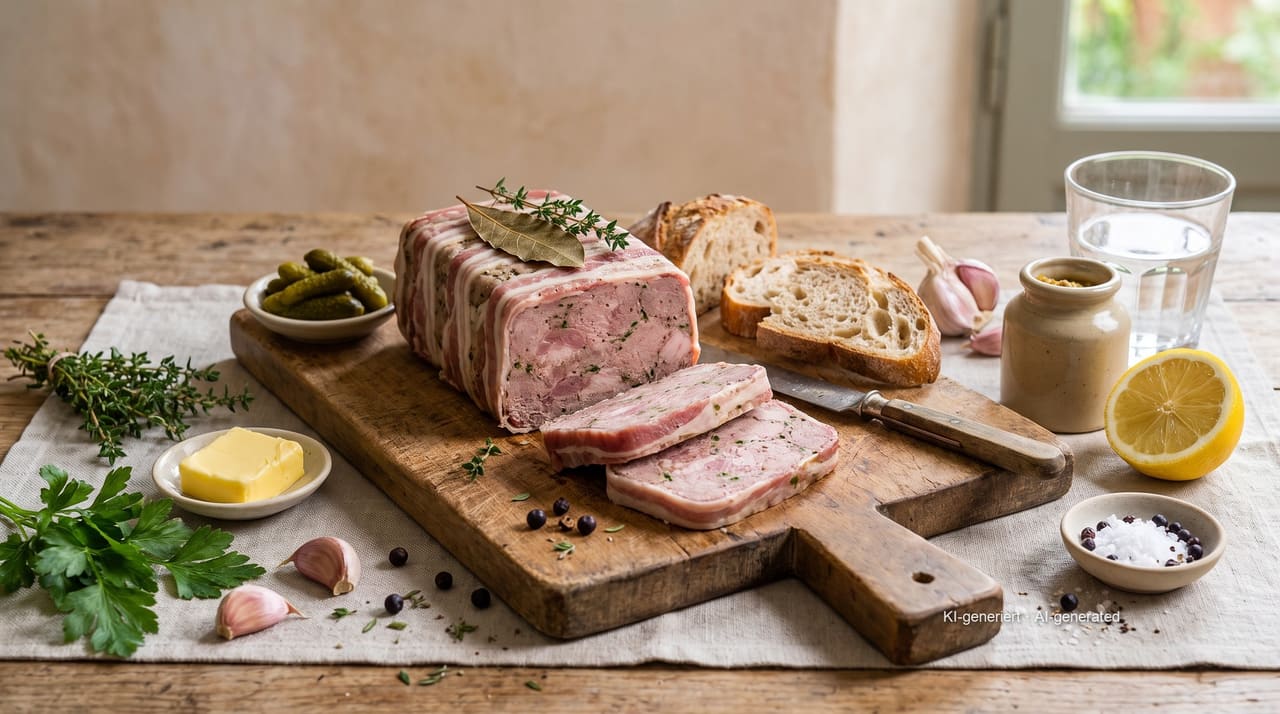
A French classic that is served all over France: terrine de campagne is the rustic country terrine of coarsely minced pork from the shoulder and belly, seasoned with shallots, thyme, quatre-épices and a splash of cognac and wrapped all round in thin slices of bacon. Cooked gently in a water bath and then left to mature for two days in the refrigerator, it becomes juicy and hearty and can be cut into firm, coarsely marbled slices; this version does without liver altogether. Makes one terrine of about 1.
145
minutes
10
servings
13
Ingredients
Instructions
Peel the shallots and garlic and chop finely. Sweat in the oil over low heat until translucent, without letting them take colour, and leave to cool on a plate.
Cut the pork belly and half of the shoulder into cubes and put through the coarse plate (8 mm) of the mincer, or have it coarsely minced by the butcher. Cut the rest of the shoulder with a knife into cubes of about 5 mm. Then wash the board, knife and hands in hot water.
Put the meat, shallots, garlic, salt, pepper, quatre-épices and the leaves of two thyme sprigs into a bowl. Add the egg and cognac and knead everything vigorously with your hands until the mixture holds together and is slightly sticky.
Put the forcemeat, covered, in the refrigerator so that the spices infuse; it may also stay there overnight.
Preheat the oven to 160 °C conventional (top and bottom heat), put the shelf on the lower level and boil a kettle full of water. Flatten a teaspoon of the forcemeat in a small frying pan and fry it through completely on both sides, leave to cool briefly and taste; season the forcemeat further if necessary.
Line a terrine mould with a lid (about 1.2 l capacity) crosswise with the bacon slices so that they overhang on both long sides.
Fill in the forcemeat in batches and press down firmly, knock the mould several times on the work surface so that no air pockets remain, and smooth the surface. Fold the overhanging bacon slices over the top, lay the bay leaves and the remaining thyme sprigs on it and put on the lid.
Stand the mould in a roasting tin or deep baking tray and pour in enough boiling water to come two thirds of the way up the mould. Cook the terrine in the water bath on the lower shelf.
Insert a meat thermometer into the middle of the terrine: the terrine is done when it shows at least 70 °C, the forcemeat has come away from the edge and the juice that runs out is clear. Otherwise keep cooking and measure again every 10 minutes.
Lift the mould out of the water bath, take off the lid and leave the terrine to cool.
Lay a suitably cut board wrapped in aluminium foil on the terrine, weigh it down with about 1 kg (for example with tins) and put it in the refrigerator like this overnight. Then take off the weight and leave the terrine to mature, covered, for a total of two days in the refrigerator.
To serve, dip the mould briefly in hot water, turn the terrine out or cut it into slices of about 1.5 cm directly in the mould.
Edited by Peter Hölzer, head chef and master butcher
Similar recipes

Culinse · 25 min
Sandre au beurre blanc — Pike-Perch with Beurre Blanc

Culinse · 250 min
Pot-au-feu — Beef Stew Pot with Vegetables

Culinse · 40 min
Salade niçoise — Salad with Tuna, Egg, Anchovies, Olives and Raw Vegetables

Culinse · 40 min
Maquereaux au vin blanc — Mackerel in White Wine Marinade

Culinse · 60 min
Salade vosgienne — Salad with Potatoes, Egg, Bacon and Crème Fraîche
Culinse · 255 min
Joues de bœuf au vin rouge — Braised Beef Cheeks in Red Wine

Culinse · 160 min
Choucroute garnie — Sauerkraut with Sausages and Meat

Culinse · 110 min