JapaneseChugokuMain courseLactose-freeHigh protein
Kaki-RamenHiroshima-style Oyster Ramen
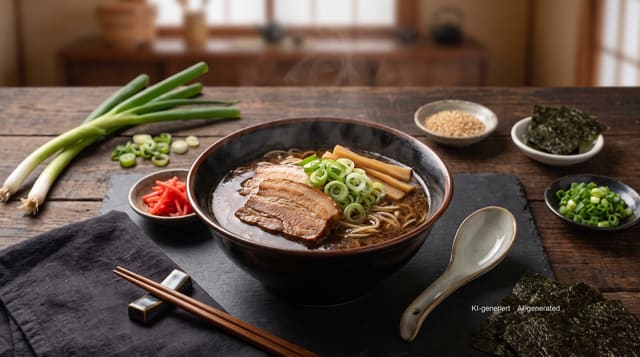
A Japanese speciality from Chugoku: Hiroshima produces more oysters than any other region of Japan, and in winter, when they are plump and sweet, they go into the ramen bowl there too — into a clear, pale golden salt broth with thin noodles, wakame, spinach and a few drops of yuzu. Unlike Hotate-Shio-Ramen — Hokkaido-style Scallop Ramen, the bowl here holds oysters, which cook through completely in the gently simmering salt broth and give it a deep, sweetish, mineral taste of the sea — the winter bowl of the oyster city of Hiroshima. Serves 4.
45
minutes
4
servings
14
Ingredients

Instructions
Thaw frozen oysters slowly overnight in the fridge beforehand. Rinse the oysters briefly in a sieve under cold water, put them in a bowl, sprinkle with the salt and swirl them gently with your fingertips until a grey, cloudy liquid forms: the salt loosens slime, sand and fine fragments of shell without damaging the delicate oysters.
Pour in cold water, move the oysters around gently in it and pour off the cloudy water; repeat until the water stays clear. As you do so, feel each oyster with your fingers and remove any hard bits of shell. Lay the oysters on kitchen paper, pat them dry from above as well and refrigerate until cooking.
Combine the tori chintan and dashi in a pot. Just wipe the kombu with a damp cloth rather than washing it — the white coating carries the flavour — then add it to the broth and warm everything slowly over a medium heat. Remove the kombu as soon as small bubbles rise at the edge of the pot, i.e. just before it boils, because if boiled along with the broth it would turn slimy and bitter.
Meanwhile, soak the wakame in a bowl of cold water until it has swollen and turned bright green; it grows to several times its size.
Bring a large pot with plenty of unsalted water to the boil; it is used first for the spinach and later for the noodles. Wash the spinach and blanch it in the bubbling water for 30 seconds until it wilts and turns bright green. Lift it out with a slotted spoon, refresh it in cold water so that it keeps its colour, squeeze it firmly and divide it into four portions.
Drain the wakame and squeeze it lightly, slice the spring onions into fine rings and halve the nori sheets. Keep all the toppings within reach next to the hob, because assembling the bowls has to be quick.
Heat the broth until it is just gently simmering — at a rolling boil it would turn cloudy. Slide in the oysters and simmer for 3 minutes, until they are firm throughout, their edges curl and their juices season the broth.
Lift out the oysters with a slotted spoon and cut a large one open to test: inside it must be firm and no longer translucent; otherwise simmer them all in the broth for another minute. Keep the oysters warm, covered, and just keep the broth hot until serving.
Fill four large bowls with hot water, leave them to stand briefly and pour the water away so that the broth stays hot in them. Put 2 tbsp shio tare and 1 tsp negi oil into each bowl; the tare provides the salt, because the broth itself is unsalted.
Loosen the noodles with chopsticks in the rapidly boiling water and cook them: fresh thin noodles for 1 to 2 minutes, dried ones according to the packet. Shake them vigorously in a sieve until hardly any water drips off, so that no cooking water dilutes the delicate broth.
Divide the hot broth between the bowls, about 400 ml each, and stir it together with the tare and oil until the salt has dissolved and small golden beads of fat float on the surface.
Add the noodles, lift them once with chopsticks and lay them back down neatly so that they lie loosely in the clear broth and do not stick together in clumps.
Arrange 3 oysters, a little wakame, spinach, 2 tbsp menma and the spring onion rings in separate groups on top of each bowl and lean two nori halves against the rim. Drizzle a few drops of yuzu juice over the broth, which will then smell fresh and lemony, and serve the ramen immediately.
Edited by Peter Hölzer, head chef and master butcher
Similar recipes
Culinse · 40 min
Ube-Ramen — Rich Yamaguchi-style Tonkotsu

Culinse · 40 min
Kaki Fry — Hiroshima-style Breaded Oysters

Culinse · 45 min
Wantan for Ramen — Filling and Folding

Culinse · 75 min
Vegan Shio-Ramen with Yuzu

Culinse · 40 min
Yasai-Ramen — Vegan Vegetable Ramen

Culinse · 35 min
Okayama-Ramen with Sweet Tonkotsu-Shoyu Broth

Culinse · 45 min
Hiroshima-Tsukemen — Spicy Cold Dipping Ramen

Culinse · 35 min